

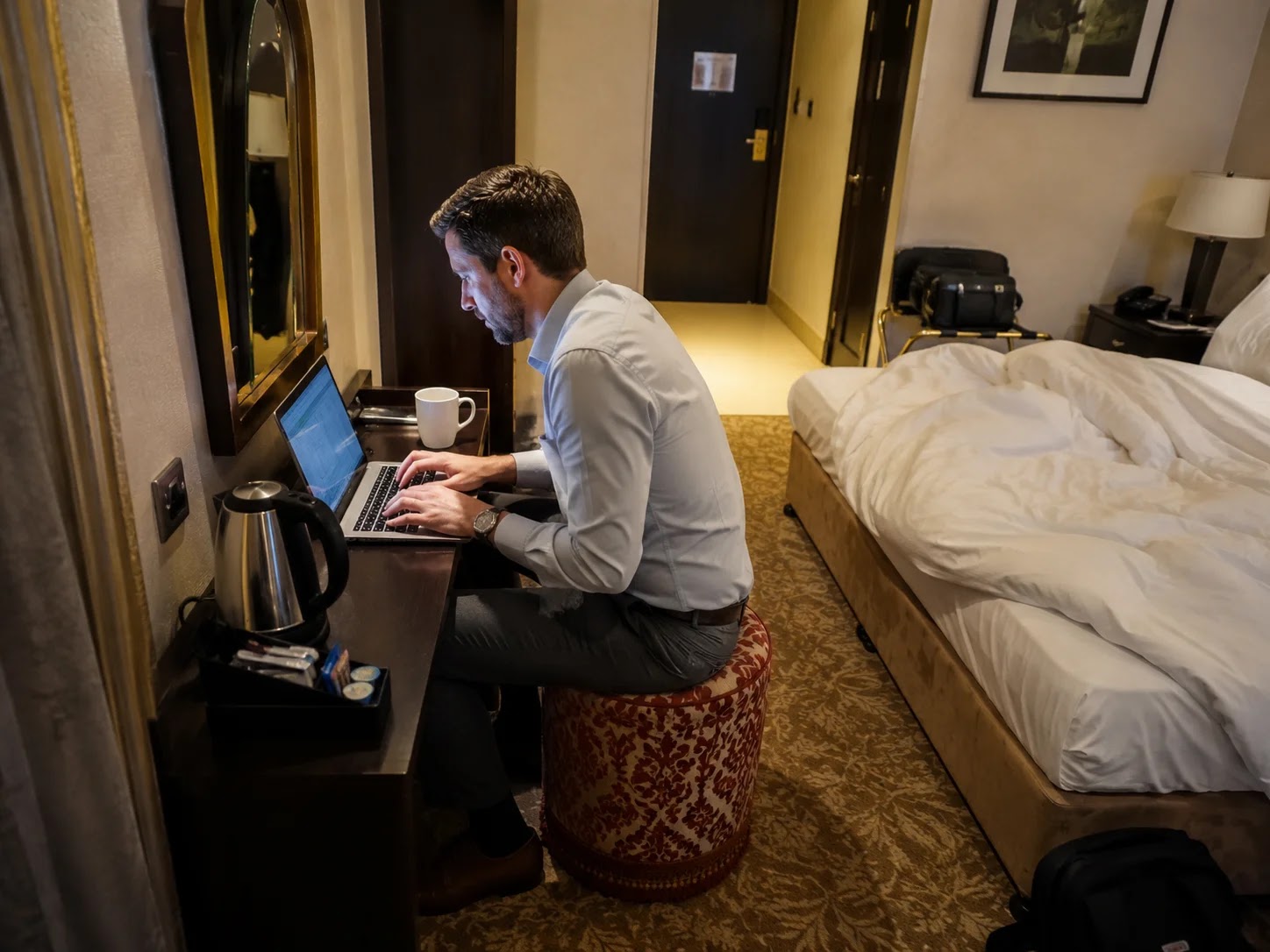
Every travelling professional has run the experiment: “I’ll just work from the hotel room — it’s right here, it’s paid for, how bad can it be?” By 11:00 you’re hunched over a dressing table, the Wi-Fi has opinions, the bed keeps making its counter-offer, and the afternoon quietly files for bankruptcy. Let’s settle the match-up honestly, category by category — then do the maths.
The point-by-point match
| Category | Hotel room | Coworking desk |
|---|---|---|
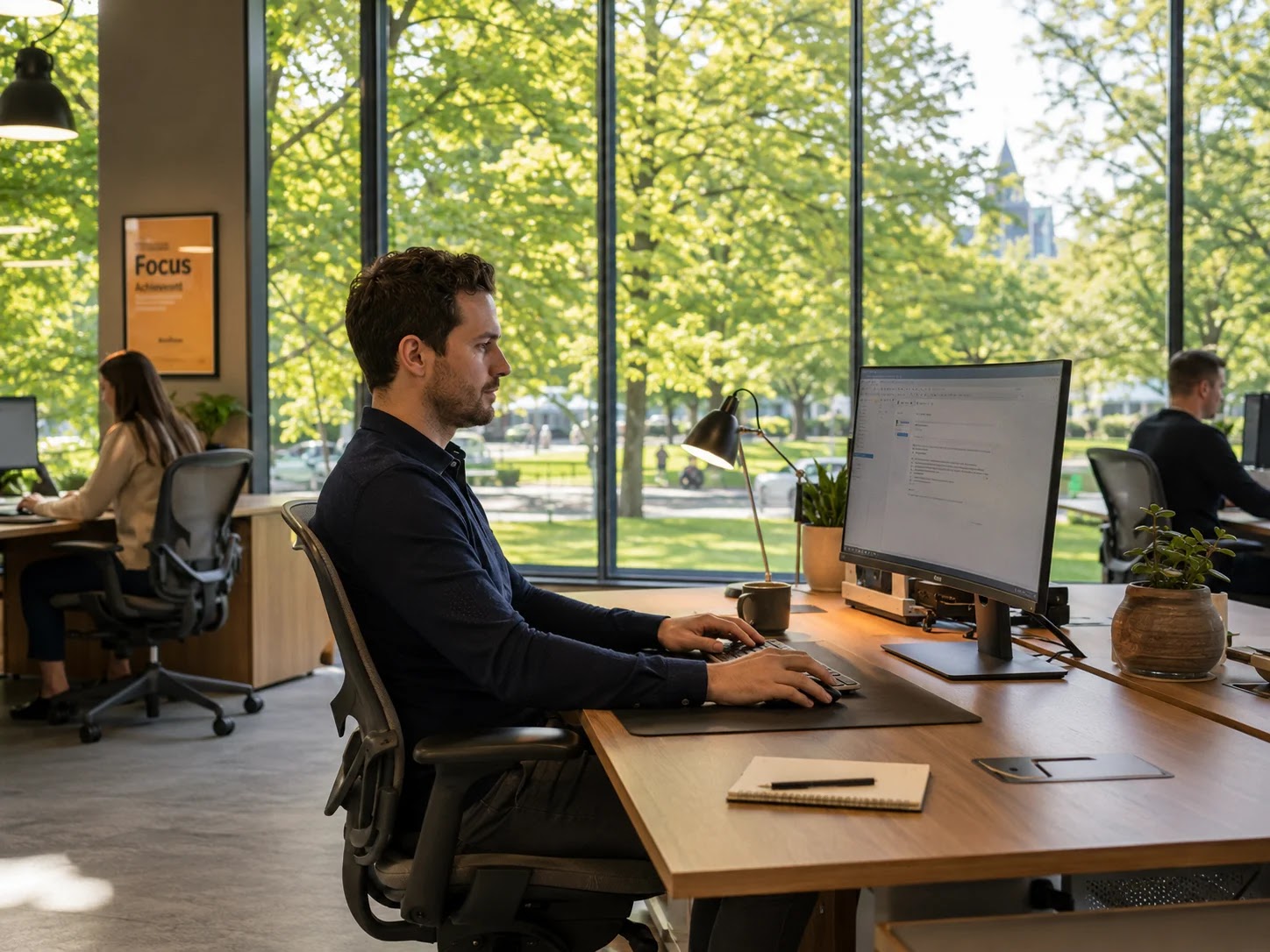
| Chair & desk | Dressing-table stool, mirror included | Actual ergonomic workstation |
| Wi-Fi under load | Shared with 40 rooms of streaming | Built for a floor of professionals |
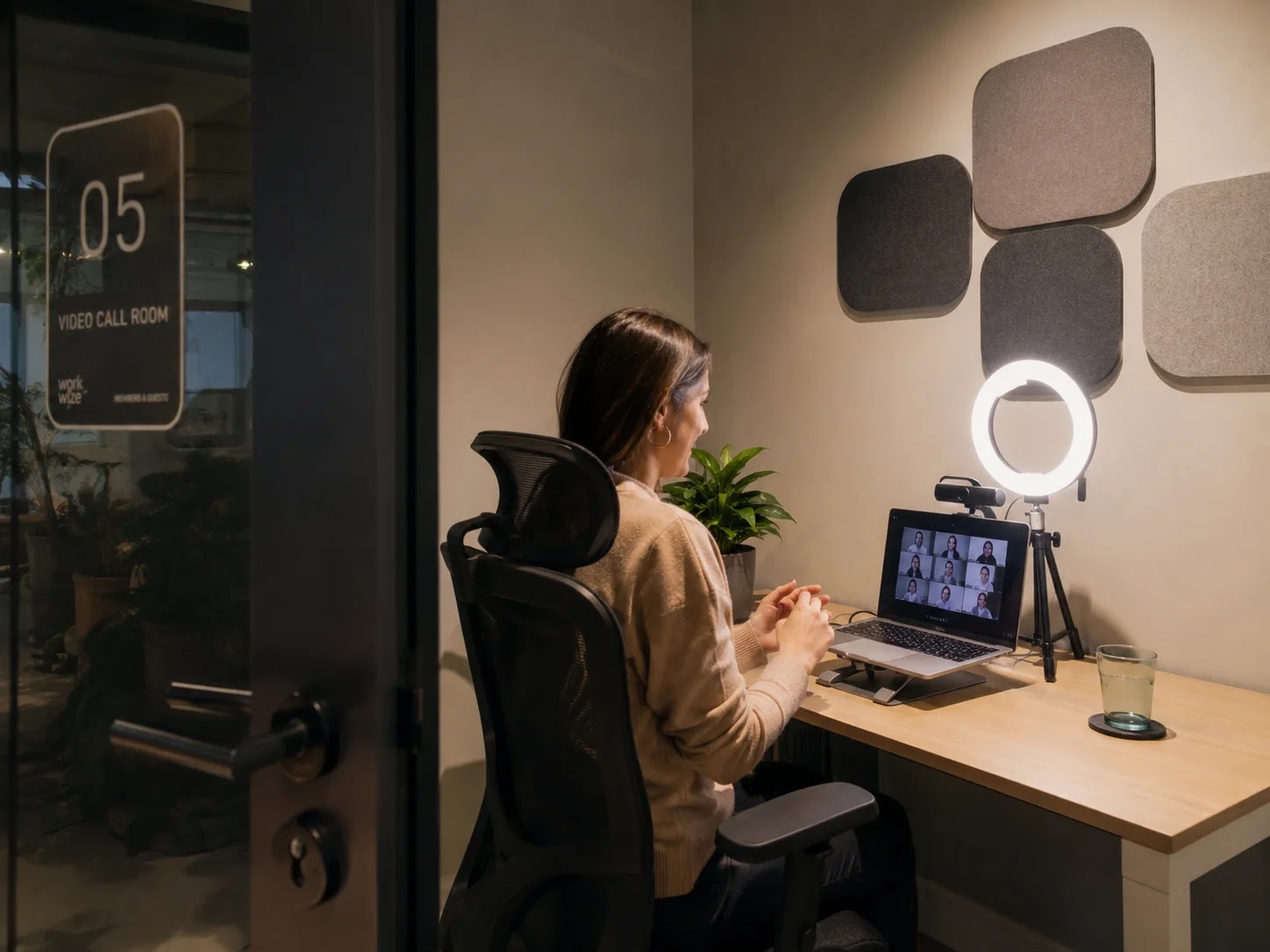
| Video calls | Headboard backdrop, housekeeping cameo | Call room: door, silence, neutral wall |
| Coffee | Kettle + sachet of disappointment | Included, unlimited, drinkable |
| Psychology | Bed radiating nap energy at 3 metres | Room full of people quietly working |
| Client meeting | “Let’s find a café…” | Bookable meeting room, free client parking |
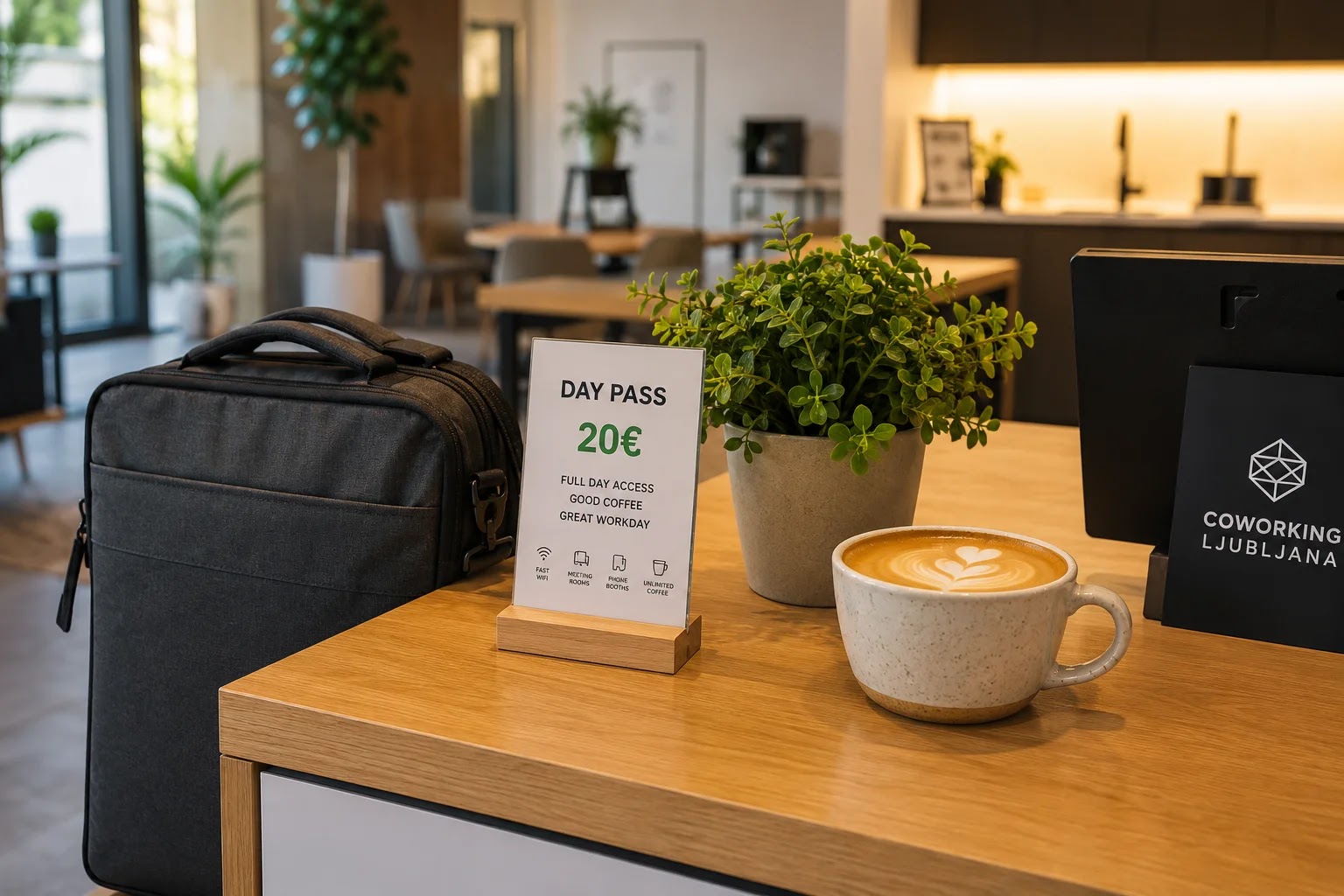
| Receipt for expenses | Buried in the room rate | Clean invoice, 20 €, self-explaining |
The psychology is the real story
The furniture is fixable with willpower; the context isn’t. A hotel room is engineered for rest — blackout curtains, soft surfaces, horizontal gravity — and your brain reads the room fluently. Work-sleep blending is precisely what ruins both: shallow work all day, restless scrolling all night. A desk you commute to, even for ten minutes, draws the line your focus needs: this building is for output, that one is for recovery. Remote-work veterans converge on this rule from every direction, usually after one too many bathrobe standups.
The maths nobody does
The hotel room feels free because it’s already paid for — but price the output, not the furniture. If a 20 € day pass at makerSP_CE turns a 40 %-effective day into a 90 %-effective one, it’s the cheapest line on the whole trip — roughly the cost of two hotel-bar beers, in exchange for the afternoon existing. Add the included coffee (two saved café rounds and it’s break-even on beverages alone), the call room, and the fact that your suitcase can sit beside the desk on checkout day, and “free” starts looking expensive.
The hybrid that actually works
This isn’t hotel-bashing — it’s job separation. The winning Ljubljana pattern: hotel for sleeping and the 07:00 e-mail skim; the desk by Tivoli for the workday; the city for everything after. Ten-to-fifteen minutes of walking connects all three, the park handles lunch, and each space does the one thing it’s built for. Your hotel becomes a better hotel the moment it stops moonlighting as your office.

Frequently asked questions
When is working from the hotel room fine?
For the bookends: a 30-minute morning triage, a late-evening wrap-up, the odd async day where calls and deep focus don’t matter. The moment the day contains a deadline, a call or four consecutive hours — book the desk.
What about the hotel’s business centre or lobby?
Lobbies are cafés with worse coffee and more rolling suitcases; business centres are usually a printer and a chair from 2009. They solve “I need a table,” not “I need a workday.”
Do I need to book the coworking desk ahead?
A short e-mail to rezervacije@makerspace.si a day ahead guarantees it; same-day usually works too. Checkout-day visitors with luggage are routine — mention the suitcase and consider it handled.
Final thoughts
The hotel room is a brilliant bedroom and a terrible office — asking it to be both is how travel days evaporate. Split the jobs: sleep where sleeping is designed, work where work is designed, and spend the recovered hours where Ljubljana is designed — outside, between a park and a castle.
Related reading
Book your desk at makerSP_CE
makerSP_CE coworking, Pivovarniška ulica 6, Ljubljana — right next to Tivoli Park. Day pass 20 €, 24/7 access, free parking, meeting room and call room included.
Web: makerspace.si | E-mail: rezervacije@makerspace.si | Phone: +386 30 393 405