
Company registration in Slovenia comes down to two realistic routes for a foreigner: a d.o.o. (limited company) with 7,500 € of minimum share capital, or an s.p. (sole proprietorship), which is straightforward for EU citizens and considerably more demanding for everyone else. Registration itself runs through the state SPOT system and is free; for a d.o.o., the court typically enters the company in the register in about four business days.
One sentence of small print before we start: this is general information, not legal or tax advice, so have a licensed adviser or notary check your specific situation before you file anything. The rules for non-EU founders in particular have enough moving parts that an hour of professional advice is the cheapest item in the whole budget.
If the simpler form tempts you, our walkthrough on how to open an s.p. covers the process itself. This guide adds the layer that foreign founders actually ask about: citizenship rules, the registered address and the tax number.
Company registration in Slovenia: pick the legal form first
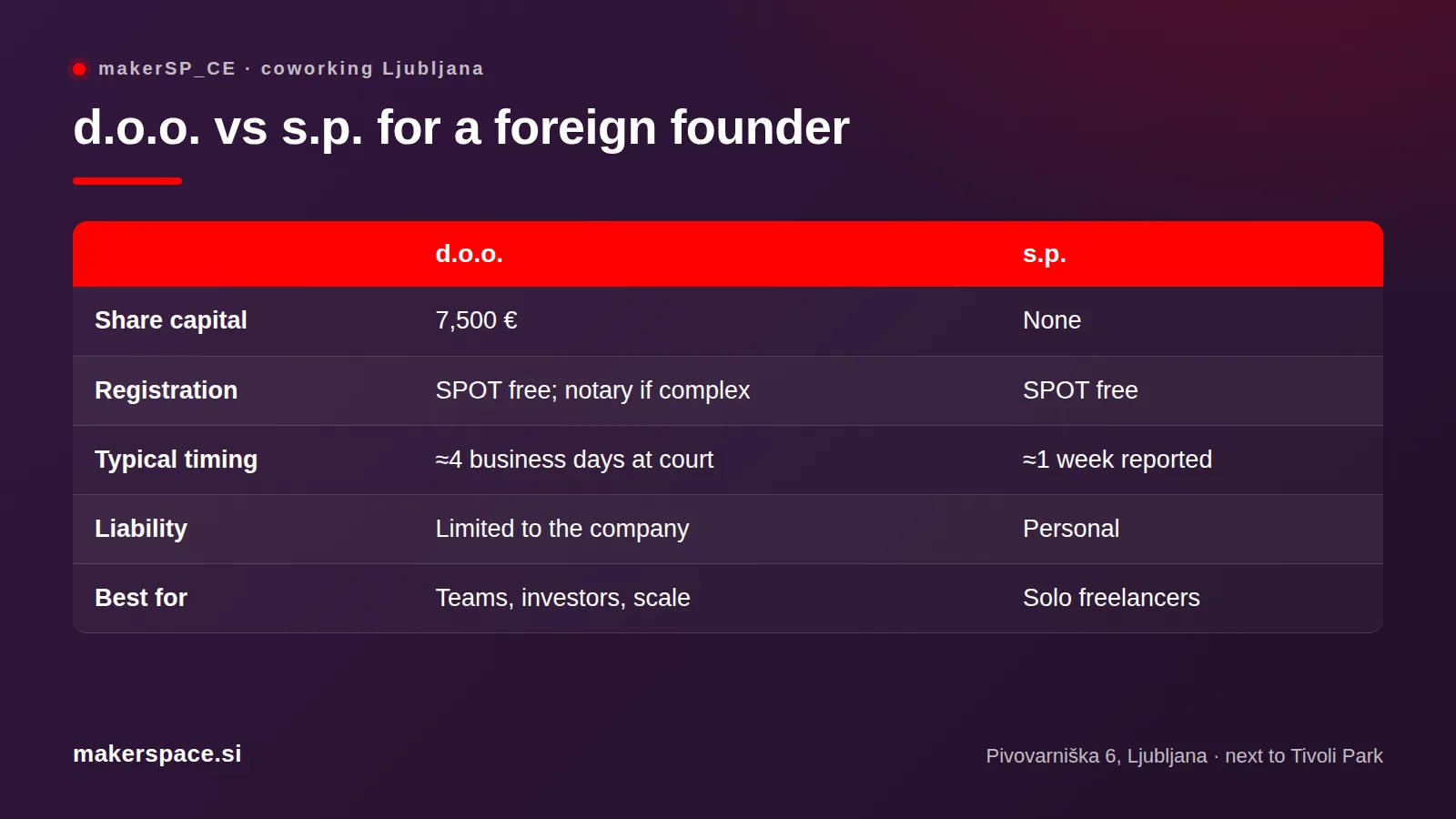
A d.o.o. is a company in its own right: it takes 7,500 € of share capital, paid in cash or in kind, and it is the form clients, investors and banks expect from anything that plans to grow. An s.p. is you, personally, doing business under a registered name, with no capital requirement and with personal liability to match. The trade-offs are the same as for locals, and our detailed comparison of sole proprietorship versus limited company walks through them.
For foreigners there is one extra rule of thumb: your passport changes the s.p. route far more than the d.o.o. route, so the honest first question is not “which form is nicer” but “which forms are realistically open to me this year”.
Registering a d.o.o.: 7,500 €, SPOT and the 15-day rule

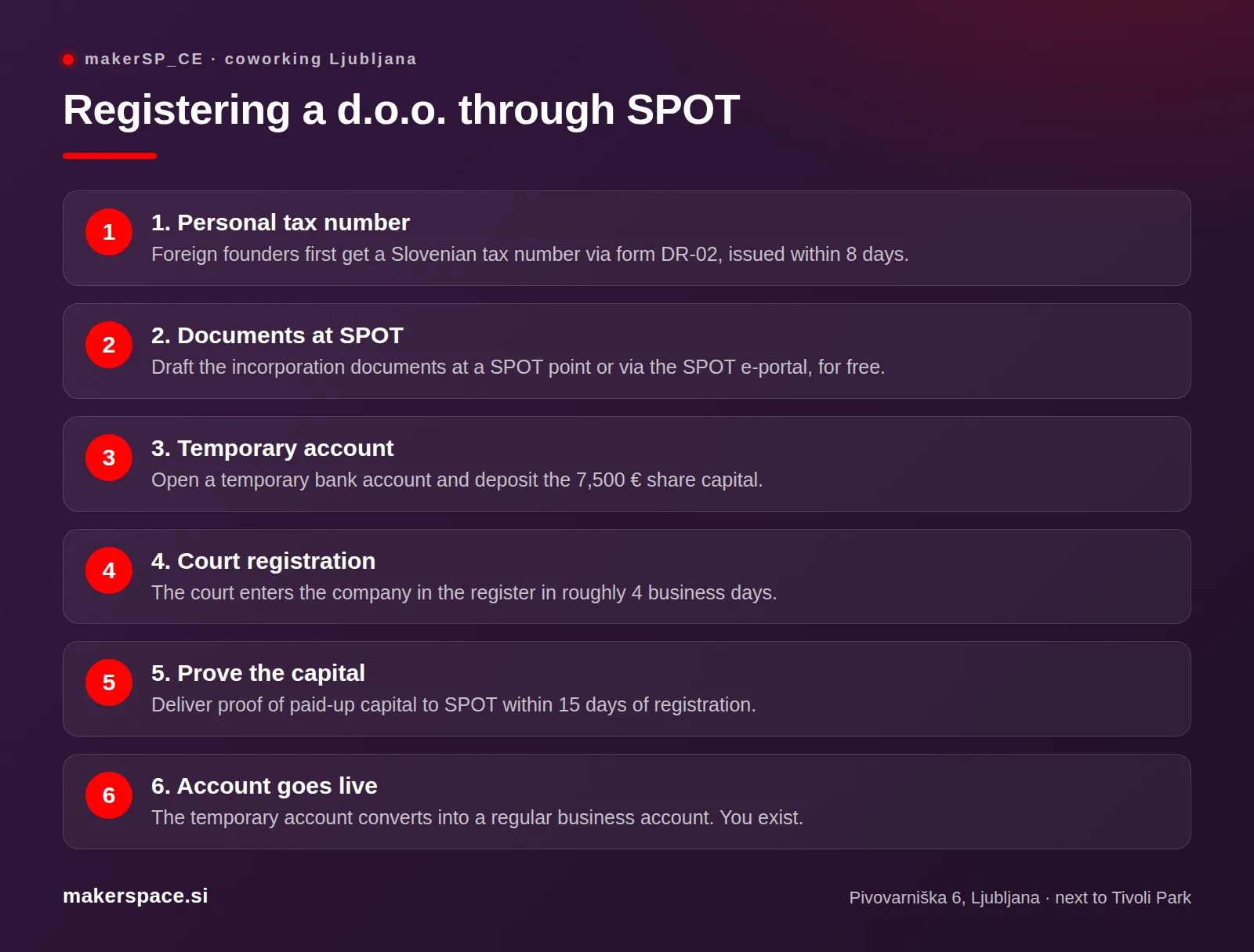
There are three ways in: the SPOT e-portal online, a SPOT točka (physical SPOT point) in person, or a notary for the complex cases. The SPOT routes are free; notary fees are separate and third-party estimates put them at roughly 300–500 €. The official SPOT pages describe the standard flow, which in practice looks like this:
1. Draft the incorporation documents at a SPOT point or through the e-portal. 2. Open a temporary bank account and deposit the 7,500 € share capital. 3. The court registers the company, typically in around four business days. 4. Deliver proof of the paid-up capital to SPOT within 15 days. 5. The temporary account converts into a regular business account.
The 15-day deadline is the step people forget while celebrating the court entry, so put it in the calendar the day you file. And if your case involves anything non-standard, ask at a SPOT point first whether the free route can handle it or a notary is required; ten minutes of asking beats re-filing.
An s.p. as a foreign citizen: an EU passport changes everything

For EU, EEA and Swiss citizens, opening an s.p. reportedly works under the same conditions as for Slovenian citizens: register, get your numbers, start invoicing. For non-EU citizens without another qualifying status, SPOT’s guidance describes a much taller order:
| Requirement | EU / EEA / Swiss | Non-EU citizens |
|---|---|---|
| Conditions | Same as Slovenian citizens | Extra conditions below |
| Bank balance | Not required | At least 10,000 € in a Slovenia-registered account |
| Premises | Not required | Proof of owned or leased business premises |
| Prior residence | Not required | Legal residence for the preceding year |
| Permit | Not needed | Residence-and-work permit, typically 30–60 days |
The business registration itself is reported to take about a week; the permit is the slow part, typically 30 to 60 days with a fee in the region of 90 €. One warning for remote workers: the digital nomad permit explicitly bars working for Slovenian clients and employers, so do not assume it doubles as a founder’s visa. If your plan is a Slovenian business, plan the immigration route with an adviser from the start.
The registered business address (poslovni naslov)
Every company and s.p. needs a registered address in Slovenia, and this is where foreign founders most often stall. The rule: if you do not own the premises, you need the property owner’s signed and certified consent. Certification of that signature is reported to cost about 3 € at an administrative unit, versus 17 € and up at a notary, which is a rare case of bureaucracy having a budget option.
Coworking and virtual-office addresses are legally valid registered seats, provided the operator supplies the consent and usage paperwork; commercial virtual-office packages in Ljubljana have been seen from around 40 € plus VAT a month. Our comparison of a virtual office versus coworking covers when each makes sense. At makerSP_CE, for clarity: a registered seat is not included in membership, but it is possible by arrangement, so write to booking@makerspace.si before you promise the registry anything.
Tax number, bank account and the first month’s rhythm

A foreign individual needs a Slovenian tax number (davčna številka) before doing much of anything official. The route is form DR-02 with the Financial Administration, filed in person, by post or through a representative; FURS issues the certificate within eight days. It is the first domino: tax number, then documents, then account, then registration.
The other early hire is an accountant. Slovenian filings run on a calendar that does not pause for founders who are still furnishing a flat, and a good accountant will also tell you which form suits your numbers before you register, not after. Our guide on how to choose an accountant lists the questions worth asking, including whether they have foreign-founder clients already.
Where to run it all from
Between SPOT appointments, bank meetings and the wait for a court entry, you still need somewhere to work, and ideally somewhere that does not demand a year-long lease before your company legally exists. This is our corner of the story. makerSP_CE is an 18-desk coworking space on Pivovarniška ulica 6, a minute from Tivoli Park: a monthly desk costs 135 € all inclusive, with no notice period, no minimum term and a price that stays fixed for as long as you stay.
The practical extras matter during a registration month: unlimited free printing for the paperwork, a 12 m² call room for calls with banks and consulates and for short one-to-one meetings with advisers, wired internet at every desk and free private parking 50 m away. A day pass is 20 € and a week 70 €, so you can scale the workspace to the bureaucracy rather than the other way round.
Frequently asked questions
How much does it cost to register a company in Slovenia?
Registration through SPOT (the e-portal or a SPOT point) is free. A d.o.o. additionally requires 7,500 € of share capital, which is your money, deposited into the company rather than a fee. Notary involvement in complex cases is reported at roughly 300–500 €, and certifying the property owner’s consent for your address costs a few euros at an administrative unit. Budget separately for an accountant and any permits.
Can a foreigner open a company in Slovenia?
Yes. The d.o.o. is the standard route, registered through SPOT with 7,500 € share capital. For an s.p., EU, EEA and Swiss citizens reportedly face the same conditions as Slovenians, while non-EU citizens typically need at least 10,000 € in a Slovenian bank account, business premises, a prior year of legal residence and a residence-and-work permit. An adviser should confirm which route your citizenship and status allow.
How long does company registration in Slovenia take?
For a d.o.o., the court typically registers the company in about four business days once the SPOT documents and capital deposit are done, and proof of paid-up capital must reach SPOT within 15 days. An s.p. registration is reported at about a week. Non-EU founders should add the residence-and-work permit, typically 30 to 60 days, which usually becomes the real timeline.
Can I use a coworking address as my registered business address?
Yes, coworking and virtual-office addresses are legally valid registered seats, provided the operator supplies the signed and certified consent and usage paperwork the registry requires. Without ownership, the property owner’s certified consent is mandatory wherever you register. At makerSP_CE a registered seat is not part of the standard membership but is possible by arrangement via booking@makerspace.si.
Do I need a Slovenian bank account to register a d.o.o.?
Yes, the standard flow includes one: you open a temporary account, deposit the 7,500 € share capital there, and after the court registers the company the temporary account converts into a regular business account. Separately, SPOT’s guidance for non-EU citizens opening an s.p. describes showing at least 10,000 € in a Slovenia-registered account. Ask your chosen bank early what documents it wants.
Final thoughts
Company registration in Slovenia is genuinely manageable: the state route is free, the timelines are short by European standards, and the traps are procedural rather than political — a missed 15-day deadline, an uncertified signature, a permit started too late. Decide the legal form with an adviser, line up the tax number and address before you file, and the rest is queueing.
We watch a fair number of companies get born at our desks, usually somewhere between the second coffee and the third printed form. If Ljubljana is where yours starts, you can test the desk before the company exists: the trial day before an open-ended monthly rental is free, and a regular daily rental at makerSP_CE costs 20 €.
Related reading
Book your desk at makerSP_CE
makerSP_CE coworking space in Ljubljana, Pivovarniška ulica 6 — right next to Tivoli Park. Day pass 20 €, week 70 €, month 135 €. 24/7 access, free parking 50 m from the door and a call room included.
Web: makerspace.si | E-mail: booking@makerspace.si | Phone: +386 30 393 405