

Monday morning. In front of you is a list of 20+ tasks. Your inbox is overflowing. Clients are waiting for a reply. A deadline is approaching. And you do not know where to start. Sound familiar? You are not alone. Research shows that the average entrepreneur or freelancer loses 2–3 hours a day due to poor time management and an inability to distinguish between the urgent and the important.
In this article we present 5 proven methods for prioritising tasks that you can start using today – in your office, at home, or in a coworking space.


1. The Eisenhower Matrix – urgent vs. important
The best-known prioritisation method, named after the American president Dwight D. Eisenhower. You divide tasks into 4 quadrants based on two dimensions: whether a task is urgent and whether it is important.
| Important | Not important | |
|---|---|---|
| Urgent | ❗ Do it NOW (deadlines, crises, urgent clients) | ➡️ DELEGATE (email, calls, admin tasks) |
| Not urgent | 📅 SCHEDULE (strategy, learning, relationships) | ❌ ELIMINATE (social media, waiting, inbox cleaning) |
How to use it: every morning, sort all tasks into the 4 quadrants. Start with quadrant 1 (urgent + important), then focus on quadrant 2 (important but not urgent) – this is the quadrant where real growth happens. Delegate tasks from quadrant 3, and eliminate quadrant 4 tasks as much as possible.
Key insight: most people spend too much time in quadrant 3 (urgent but unimportant) – answering emails, unproductive meetings, interruptions. The more time you spend in quadrant 2, the more successful you will be in the long run.

2. The Pomodoro Technique – work in 25-minute blocks
Developed by the programmer Francesco Cirillo in the 1980s. The idea is simple: work for 25 minutes without interruption, then take a 5-minute break. After 4 cycles, take a longer break (15–30 minutes).
How it works in practice:
- Choose a task from your priority list.
- Set a timer for 25 minutes – use a phone, a clock, or an app (e.g. Focus Keeper, Forest).
- Work without interruption – no phone, no email, no conversations.
- When it rings, take a 5-minute break – stand up, walk, drink water.
- After 4 cycles: a 15–30 minute longer break.
Why it works: a limited timeframe reduces the resistance to starting a task (“just 25 minutes”) and encourages deep focus. Regular breaks prevent burnout. At a coworking space like makerSP_CE you have ideal conditions: a quiet workspace and a balcony by Tivoli Park for a refreshing break between cycles.


3. The Pareto Principle (80/20) – focus on the 20% that brings 80% of results
The 80/20 rule, discovered by the Italian economist Vilfredo Pareto, states: 80% of results come from 20% of activities. This means that most of your earnings, progress, and client satisfaction come from a minority of your tasks.
How to apply it:
- Identify your 20% – which tasks actually bring revenue, clients, or progress?
- Give them the most energy – do them first, when you are sharpest (usually in the morning).
- Reduce the other 80% – delegate, automate, or eliminate tasks that do not bring results.
Example: if you are a freelancer, your key 20% is probably: client work (which brings revenue) and networking (which brings new clients). Admin tasks, email, and social media fall into the remaining 80%.
4. The ABCDE Method – rank tasks by priority
A simple method recommended by the motivational author Brian Tracy. Label each task with a letter:
- A – must do (serious consequences if I do not)
- B – should do (minor consequences if I do not)
- C – nice to do (no consequences if I do not)
- D – delegate (can someone else do this instead of me?)
- E – eliminate (do I even need to do this?)
Rule: never start a B task until all A tasks are done. And never start a C task until all B tasks are done. This prevents “productive procrastination” – doing smaller tasks to avoid the bigger ones.
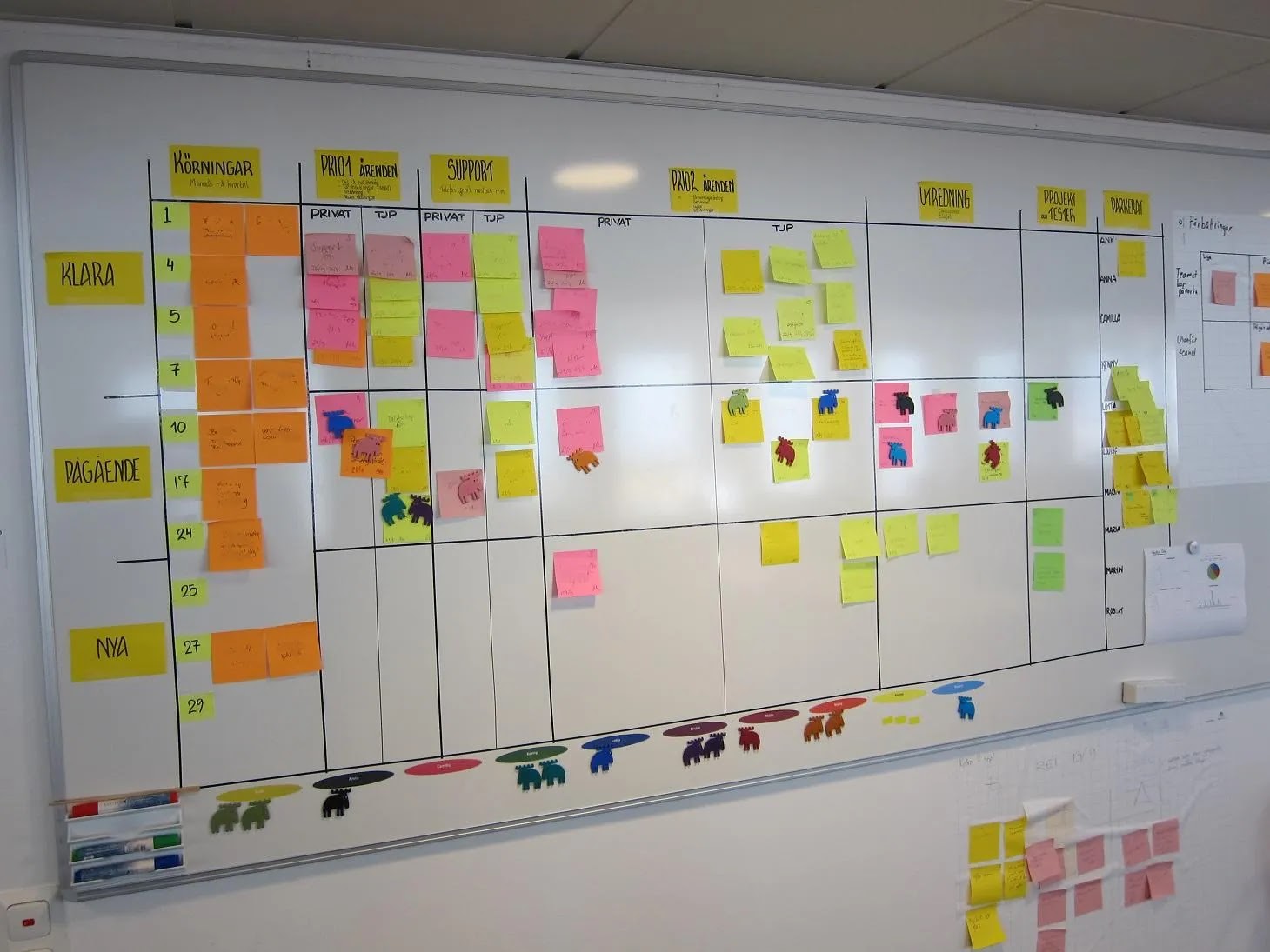
5. The Kanban board – visualise your workflow
Kanban (Japanese: “visual board”) is a method where you divide tasks into columns:
- To Do – all the tasks waiting for you
- In Progress – tasks you are currently working on (ideally: 2–3 at most at once)
- Done – completed tasks (a motivational effect!)
Tools for Kanban: Trello (free), Notion, Asana, or simply post-it notes on the wall. Key principle: limit the number of “In Progress” tasks to 2–3 at a time. This prevents scattering and encourages focus.

Which method is right for you?
| Method | Best for | Key advantage |
|---|---|---|
| Eisenhower | Entrepreneurs with many tasks | Separates urgent from important |
| Pomodoro | Freelancers, screen work | Deep focus + breaks |
| Pareto 80/20 | Startup founders | Focus on the highest-impact activities |
| ABCDE | Anyone with a long task list | Simplicity and clarity |
| Kanban | Teams and project work | Visualising progress |
Tip: choose one method and test it for 2 weeks. Do not switch methods every day – give each enough time to see results. Most people end up combining elements of several methods into their own system.



Why the work environment is key to productivity
No prioritisation method helps if you work in an environment that constantly interrupts you. Working from home – with the washing machine, the fridge, and family members – is often disastrous for productivity. That is why more and more freelancers and entrepreneurs choose a coworking space: a professional environment that encourages focus, with a private call room and a quiet space for deep work.
At makerSP_CE you have ideal conditions: a quiet work environment, a call room for undisturbed video calls, a balcony by Tivoli Park for breaks between Pomodoro cycles, and a community that motivates you. All from €135/month.
Frequently asked questions about task prioritisation
Which method is best for beginners?
The Eisenhower Matrix – it is the simplest to understand and immediately usable. Start with it and then add Pomodoro for executing tasks.
Can I combine several methods?
Absolutely. The most common combination: Eisenhower for setting priorities + Pomodoro for execution + Kanban for visualising progress.
How do I avoid procrastination?
Use the “two-minute rule”: if a task takes less than 2 minutes, do it immediately. For bigger tasks, use Pomodoro – “just 25 minutes” is easier to start than “do the whole project”.
Which apps do you recommend?
Todoist or TickTick for task lists, Trello or Notion for Kanban, Forest or Focus Keeper for the Pomodoro timer, Google Calendar for time blocks.
How do I prioritise when everything is urgent?
When everything seems urgent, ask yourself: “What happens if I do NOT do this today?” If the answer is “nothing serious”, the task is not really urgent. Rule: at most 3 tasks a day can be marked as an “A” priority.
Conclusion: Productivity is not how much you work – it is how much you get done
Prioritisation is not just a technique – it is a mindset. It is about understanding that your time is not unlimited and that not everything is equally important. The smartest entrepreneurs are not the ones who work the most hours – but the ones who do the right things at the right time. Choose a method that suits you and start using it today.
And if your work environment does not support focus, it is time for a change. Come for a tour of the makerSP_CE coworking space – bookings at rezervacije@makerspace.si or +386 30 393 405. For extra motivation, also read the article How to stay motivated as a startup founder.
⏰ Work smarter, not harder.
makerSP_CE – a space for focused work | €135/month | All-inclusive