

Ljubljana expats share a running joke: you meet the same people three times in your first month. That is not a bug. In a capital you can cross on foot, familiarity compounds fast, and the quickest way to build a social life is to pick a regular place and keep turning up: a coworking desk, a sports group, a language exchange, a volunteer shift. English gets you through nearly every conversation, so the only real barrier is showing up.
This guide is about where those regular places are and what living in Ljubljana as a foreigner costs and feels like: the coworking community at makerSP_CE, the kinds of groups worth joining, the everyday practicalities of Urbana cards and malica, neighbourhood notes and the honest downsides. For a stay of months rather than years, our digital nomad guide to Ljubljana covers the short version.
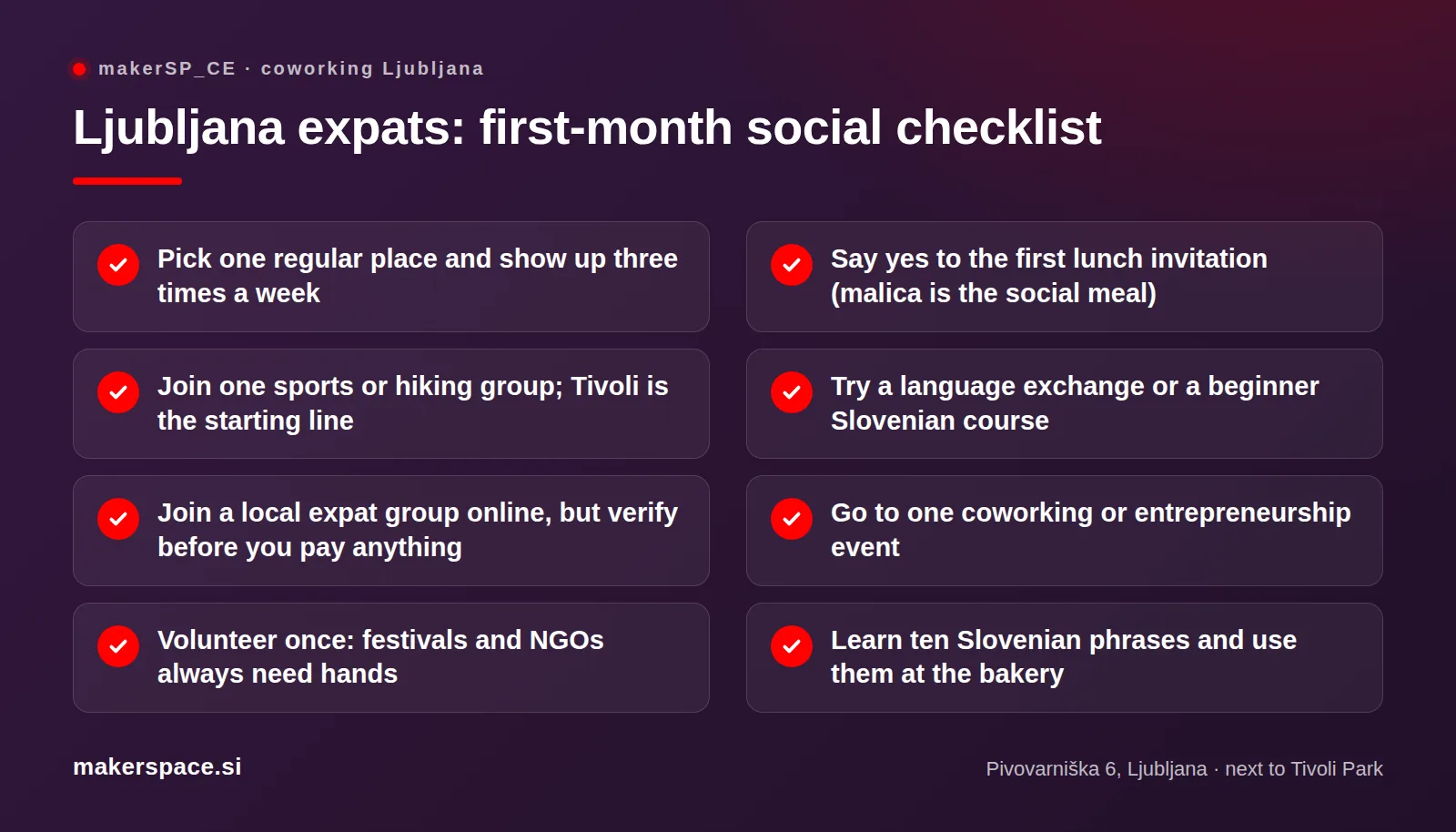
How Ljubljana expats actually meet people
The expat community Ljubljana has grown around a few recurring formats, and they all reward repetition over charm.
- A coworking community. Our own philosophy is that we have no tenants, only colleagues and friends. The members at makerSP_CE are freelancers, founders, remote employees and students, the kitchen is a free-for-all, and the free coworking events, workshops and get-togethers are where new arrivals stop being new. A monthly desk costs 135 €, with no notice period if your plans change.
- Meetups and language exchanges. Tech and design meetups, board-game evenings, language tandems where you swap English for Slovenian, book clubs and founder breakfasts all run in the city. Look for them through event listings and expat groups, and pick one recurring format rather than a different one every week.
- Hiking, running and sport. Slovenians socialise outdoors. Tivoli Park has running groups and the walk up Rožnik; Šmarna gora is the city’s weekend hill; climbing, cycling and football groups welcome newcomers who can commit to a regular slot.
- ESN, if you are a student. The Erasmus Student Network runs under ŠOU, the university’s student organisation, and its events are the fastest route into the international student crowd.
- Expat groups online. Local expat and community groups on social networks are where flats, second-hand furniture and practical advice circulate. Useful, occasionally full of nonsense, so verify anything involving money before you pay.
- Volunteering. Festivals, sports events and NGOs need hands, and a volunteer shift puts you next to locals with nothing to sell you.
- Entrepreneur networking. If you run a business, the city’s startup and business events are small, informal and unusually open to foreigners; our guide to networking for entrepreneurs explains how to turn a handshake into work.
Everyday practicalities: English, Urbana, malica

Three things make the first weeks smoother. First, the language question mostly answers itself: English is spoken in shops, offices and cafés, and a handful of Slovenian phrases is a courtesy rather than a requirement. Second, transport is simple. The city bus network runs on the Urbana card (2 € for the card, 1.50 € per ride with free transfers for 90 minutes, 37 € for the general monthly pass and 20 € for students), and the BicikeLJ bike-share scheme covers the rest.
Third, lunch is the social meal. The weekday malica or dnevno kosilo, soup plus a main course for roughly 7–10 €, is where colleagues talk, and being invited to one is a small social milestone. Coffee culture is the other half; our field guide to coffee in Ljubljana is a good map of where people linger. On safety, the short version is that the city is comfortable to walk at night; the longer version is in our honest safety review.
What living in Ljubljana as a foreigner costs

Rent is the number that decides everything else. Crowd-sourced cost-of-living data from August 2026 puts a one-bedroom flat in the centre at roughly 900–950 € a month and one outside the centre at 650–770 €, with utilities for a larger flat around 270 €. Everyday items are gentler: a cappuccino is about 2–2.50 €, a half-litre of local beer around 3.50 €, an inexpensive restaurant meal around 14 € and a gym membership 48–55 €.
One aggregator estimates a single person’s monthly budget, rent included, at about 1,860 €, against an average net salary of roughly 1,745 €. Treat every figure as a rough guide; the point is the proportions.
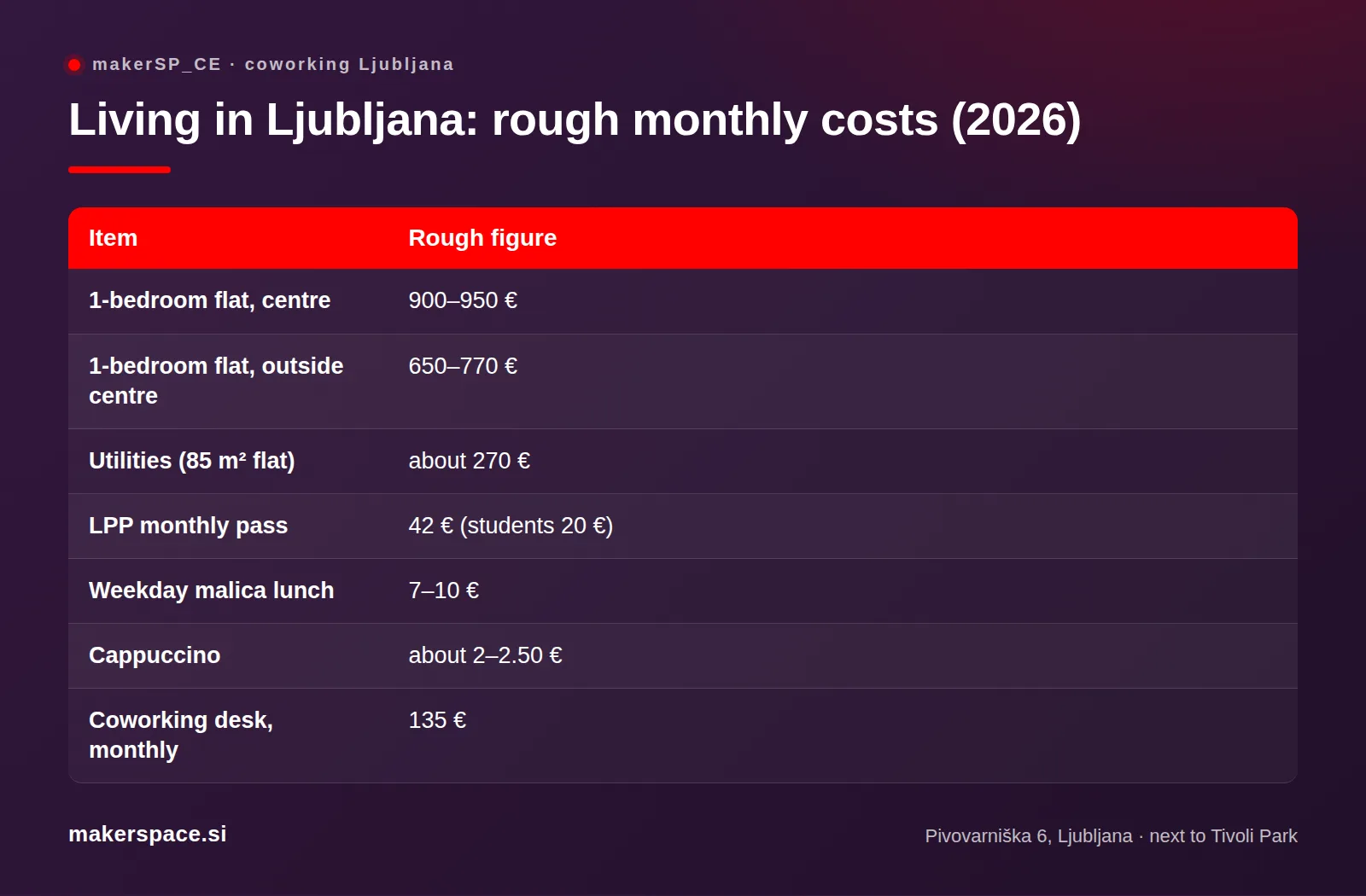
Neighbourhood notes: Center, Šiška, Bežigrad, Vič and Rožna dolina
Every neighbourhood is a bike ride from every other, so choose by mood rather than commute. There is no official rent-by-district data, so use listing portals and your own viewings for prices.
| Neighbourhood | Character | Suits |
|---|---|---|
| Center | riverside, old town, priciest, tourist buzz | short stays, people who want everything on foot |
| Šiška | residential, cultural venues, Tivoli on the doorstep | long-term renters, families, park runners |
| Bežigrad | north of the centre, faculties, main station side | students, commuters, train travellers |
| Vič | south-west, green, quieter, near Rožnik hill | families, cyclists, people who like quiet |
| Rožna dolina | leafy, student halls, between Vič and Tivoli | students, anyone who wants trees and a short walk in |
makerSP_CE sits at Pivovarniška ulica 6 on the Študentski kampus, a minute from Tivoli Park, an eight-minute walk from Prešeren Square, on LPP lines 1, 3, 5, 6, 7, 8 and 25, with a free private car park 50 metres away and a BicikeLJ station on the campus. From Šiška, Center or Rožna dolina it is comfortably on foot.
A coworking desk as your social anchor

The reason we keep recommending a coworking desk to new arrivals is not the desk. It is the repetition. Turn up three mornings a week and within a month you have people to lunch with, someone who knows an accountant and an invitation to a Saturday hike.
At makerSP_CE a day pass is 20 €, a week 70 € and a month 135 €, VAT included, with no surcharges, no minimum term and a price that never rises once you have signed up. The month can be frozen while you travel or shared with a partner or friend at no extra cost. Inside: a fixed desk with wired internet, a loan monitor, unlimited free printing, a meeting room and a 12 m² call room without a booking system, a stocked kitchen, 24/7 access for monthly members and a balcony over the park. There are only 18 desks, so ask about availability first.
The honest downsides of expat life in Ljubljana
- It is small. After a year you will know the barista, the barista’s cousin and everyone at the meetup. Wonderful for belonging, less so if you want anonymity or a different scene every weekend.
- Winter is grey. The basin traps fog and low cloud between November and February. Plan for it: a bright desk, lunchtime walks in Tivoli and weekend escapes to the mountains, which are usually above the murk.
- Housing is tight. Good flats go quickly, deposits are standard and competition peaks in early autumn when students return. Start early, view in person and never pay before a contract.
- Official life happens in Slovenian. Forms, contracts and letters from institutions arrive in Slovenian. Budget for a translator or a helpful local until your vocabulary catches up.
- Circles open slowly. Slovenians are reserved on first contact and loyal after the third. Repetition, again, is the whole strategy.
Frequently asked questions
Is Ljubljana a good city for expats?
Yes, if you value walkability, safety, nature within minutes and a manageable cost of living over big-city anonymity. English is widely spoken, the international community is small but active, and a coworking desk or a sports group gives you a social circle within weeks. The trade-offs are grey winters, tight housing and a scene that stays pleasantly small.
How do I meet people in Ljubljana as a foreigner?
Pick one regular place and repeat. A coworking community such as makerSP_CE, a running or hiking group in Tivoli Park, a language exchange, a recurring meetup or a volunteer shift all work, provided you show up more than once. Slovenians warm up on the second or third meeting, and lunch invitations are the sign you are in.
Do I need to speak Slovenian to live in Ljubljana?
Not for daily life: shops, cafés, doctors and offices generally handle English well. You will want Slovenian for official paperwork, which arrives in Slovenian, and for the social depth that comes with local friends. A beginner course or a weekly language exchange is a good first-year investment and doubles as a way to meet people.
Which neighbourhood in Ljubljana is best for expats?
Center for a short stay with everything on foot, Šiška for a residential base next to Tivoli Park with good buses, Bežigrad near the faculties and the station, Vič or Rožna dolina for green, quiet streets. All are within a bike ride of each other, so choose by mood and budget, and view flats in person before paying anything.
How much does it cost to live in Ljubljana as a single person?
Rough 2026 figures: a one-bedroom flat at 650–950 € depending on location, utilities around 270 €, a 37 € bus pass, weekday lunches at 7–10 € and coffee at about 2 €. One aggregator puts a single person’s total monthly budget at about 1,860 €. Add 135 € if you want a monthly coworking desk with everything included.
Final thoughts
Expat life in Ljubljana rewards the person who commits to a routine early: the same desk, the same lunch crowd, the same Saturday hill. In a city this size, that routine turns into a community faster than anywhere else we know.
If you would like the routine to start with a desk next to Tivoli Park and colleagues who will invite you to lunch, come and see us; a day pass costs 20 € and a month 135 €.
Related reading
Book your desk at makerSP_CE
makerSP_CE coworking, Pivovarniška ulica 6, Ljubljana — right next to Tivoli Park. Day pass 20 €, week 70 €, month 135 €. 24/7 access, free parking 50 m from the door, meeting room and call room included.
Web: makerspace.si | E-mail: rezervacije@makerspace.si | Phone: +386 30 393 405


