

Ljubljana vs Zagreb is the comparison most remote workers in this corner of Europe end up making, so here is the short answer: Zagreb is a little cheaper and its digital nomad permit runs longer, while Ljubljana is smaller, greener, easier to walk and has had its own nomad permit since November 2025. Widen the frame and Vienna is clearly the most expensive of the four and the only one with no nomad visa at all, while Budapest sits close to Zagreb on cost with a two-year White Card. On Numbeo’s Cost of Living Plus Rent index (August 2026, New York = 100) that reads Vienna 54.7, Ljubljana 43.9, Budapest 39.3, Zagreb 38.5.
Which city works best depends on what you are optimising for, so this guide compares the four on cost, permits, size, nature, English, internet and rail, then gives a verdict by persona. This is general information, not legal or tax advice; confirm permit rules with official sources before you book anything. If Ljubljana is already your front-runner, our honest pros-and-cons review and the Ljubljana digital nomad guide go deeper.

Cost of living: Vienna 54.7, Ljubljana 43.9, Budapest 39.3, Zagreb 38.5
Numbeo’s Cost of Living Plus Rent index folds rent, groceries, restaurants and transport into one number against New York at 100. On the August 2026 snapshot the ordering is unambiguous: Vienna is the outlier at the top, Ljubljana sits in the middle, Budapest and Zagreb are close together at the bottom. On the Ljubljana vs Vienna cost of living question, Vienna comes out roughly a quarter more expensive on this measure; Ljubljana vs Budapest is closer, with Budapest and Zagreb about a tenth cheaper. The index is crowd-sourced and moves – treat it as an ordering, not a decimal truth.
In Ljubljana specifically, Numbeo and Expatistan (August 2026) put a one-bedroom flat at roughly 900–950 € a month in the centre and 650–770 € outside it, against an average local net salary of about 1,745 € (Numbeo). A monthly coworking desk at makerSP_CE is 135 €, all inclusive. We do not quote rents for the other three cities because we have not verified them to the same standard; the index is the honest like-for-like.
Digital nomad permits: who lets you stay, and for how long

Again: general information, not legal advice. Thresholds change; check the official portals.
- Slovenia. The temporary residence permit for digital nomads has been in force since 21 November 2025 (gov.si). It runs up to one year, is not extendable, and you may reapply six months after it expires. You must work for employers or clients based outside Slovenia – the permit bars entering the Slovenian labour market – and show monthly funds of at least twice Slovenia’s average net salary, roughly 3,122 € a month at launch and rising with the reference figure. Holding it does not automatically make you a tax resident; that is assessed separately, with more than 183 days in a calendar year as the usual trigger. Our Slovenia digital nomad visa overview has the detail.
- Croatia. A digital nomad permit for up to 18 months with a possible six-month extension, and an income threshold of roughly 3,295 € a month (or a savings equivalent), according to aggregator sources; verify on Croatia’s official portal.
- Hungary. The “White Card” residence permit for remote work runs one year plus one renewal, two years in total, with an income threshold of roughly 3,000 € net a month that adjusts annually.
- Austria. No dedicated digital nomad visa. The nearest route, the Red-White-Red Card, is designed for key workers and self-employed founders bringing significant capital, not for remote employees of foreign companies.
If you hold an EU passport, none of this affects your right to stay – though tax residency rules still apply everywhere.
Daily life: size, nature, English and internet

Size and walkability
Ljubljana is by far the smallest of the four, a capital you can cross on foot; Prešernov trg is an 8-minute walk from our desks and Tivoli Park starts about 100 m from the door. Vienna and Budapest are big imperial capitals with metro systems and the commutes that go with them. Zagreb sits in between: a proper city, but one where the centre still works on foot and tram.
Nature
Ljubljana has a park in the middle and the Alps, the coast and the karst caves within day-trip range. Vienna has the Wienerwald and the Danube; Budapest the Danube and its thermal baths; Zagreb the Medvednica hills and the Adriatic beyond. All four score well; Ljubljana is the one where nature starts before the commute ends.
English
You will manage in English in the centre of all four. Ljubljana punches above its size: English is spoken widely and well, which matters when you are dealing with landlords and the administrative unit rather than waiters.
Internet and time zone
A secondary aggregation of 2025 median fixed-broadband speeds puts Hungary fastest at roughly 237 Mbps, then Slovenia at about 130, Austria around 114 and Croatia around 113 – a rough ordering, not a promise. At the desk it matters less: every desk at makerSP_CE has wired ethernet plus two fast Wi-Fi networks. All four cities share Central European Time, which is why CET is the sweet spot for anyone juggling London and New York.
Ljubljana vs Zagreb: the head-to-head most people actually ask about
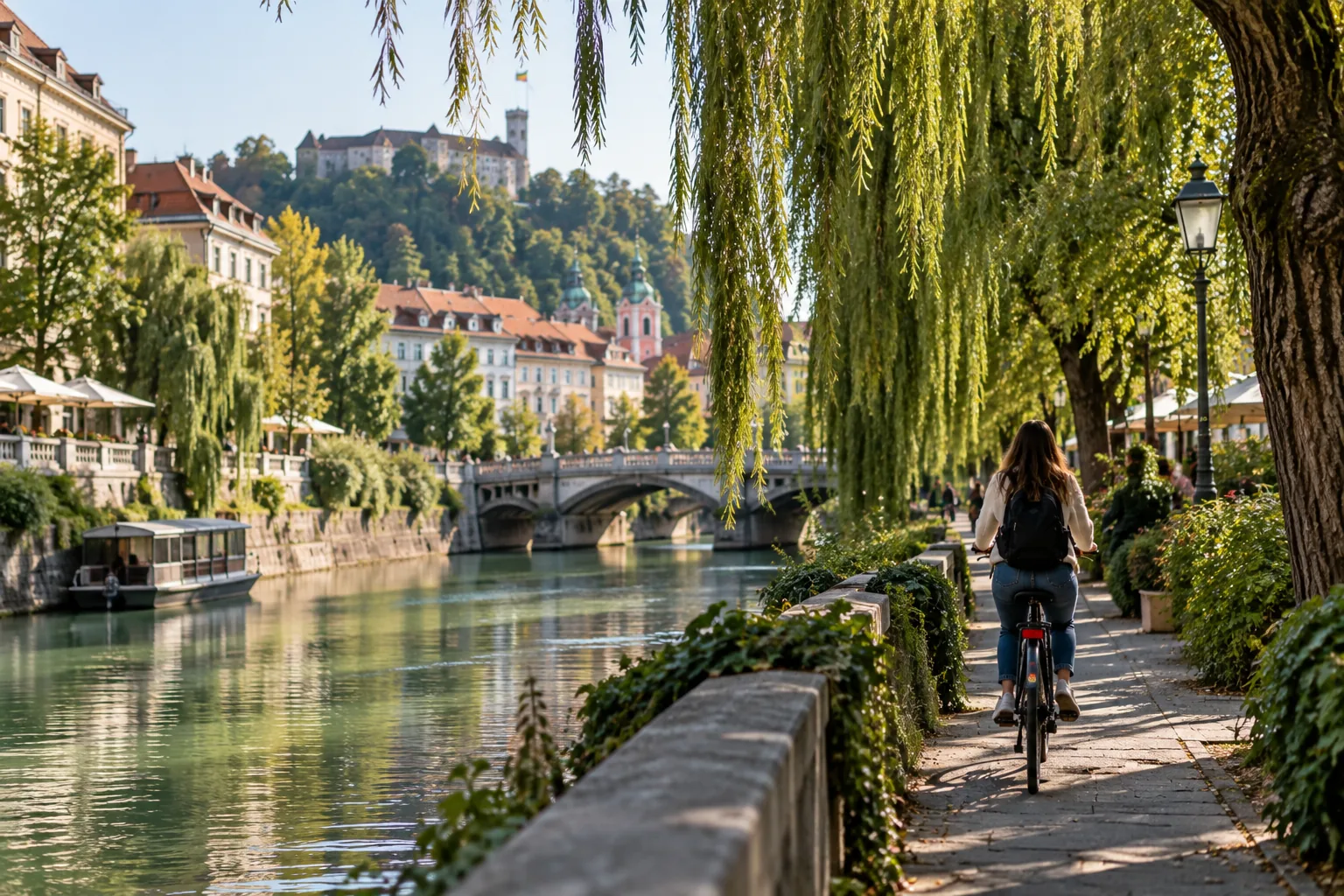

The two capitals are close enough that you do not have to choose for good. Slovenske železnice runs about nine direct trains a day between them, the fastest taking around 2 hours 47 minutes, with tickets from 9 € (SŽ international timetable). Base yourself in one and spend a weekend in the other.
| Ljubljana | Zagreb | |
|---|---|---|
| Numbeo cost + rent index (Aug 2026) | 43.9 | 38.5 |
| Nomad permit | up to 1 year, reapply after 6 months | up to 18 months + 6-month extension |
| Income threshold (approx.) | 2× average net salary, ≈3,122 € at launch | ≈3,295 € a month (aggregator figure) |
| Size | small capital, walkable end to end | mid-sized city, centre walkable |
| Nature | park in the centre; Alps, coast, caves | hills behind the city; long coast beyond |
Vienna, for completeness, is roughly five to six and a half hours from Ljubljana by train, with about one direct service a day and fares from roughly 27–36 € according to booking aggregators. For Budapest, check the SŽ timetable; we have no direct figure we can vouch for. If you shuttle between these cities for meetings, our business travel to Ljubljana guide covers where to work in between.
Verdict by persona
- Budget first, foreign income. Zagreb or Budapest on the index. Choose Ljubljana if a walkable city and a park on the commute are worth roughly a tenth more.
- Deep-work freelancer who hates commuting. Ljubljana. Small city, fixed desk with your own keys, everything within a short walk.
- Big-city culture, nightlife and museums. Vienna if the budget stretches, Budapest for value. Ljubljana’s evening is riverside bars and a castle, not a metropolis.
- Stay as long as possible on one permit. Croatia’s 18 plus 6 months beats Hungary’s two years and Slovenia’s one; Austria offers no remote-work route at all.
- Regional hopper. Ljubljana as the hub: Zagreb under three hours by train, Vienna a half-day by rail, the airport 25 km from the centre.
Ljubljana’s small-city premium cuts both ways. You pay a little more than Zagreb or Budapest for a city with fewer nomads, fewer events and fewer flats. In return, the desk, the main square, the park and free parking all sit within an eight-minute walk of each other.
Frequently asked questions
Is Ljubljana or Zagreb better for digital nomads?
Zagreb wins on cost (Numbeo index 38.5 against Ljubljana’s 43.9, August 2026) and permit length (up to 18 months plus a six-month extension against Slovenia’s one year). Ljubljana wins on size, walkability, English and the park at the centre. With about nine direct trains a day and tickets from 9 €, many people base in one and visit the other.
Is Ljubljana cheaper than Vienna?
Yes, clearly. On Numbeo’s Cost of Living Plus Rent index (August 2026) Ljubljana scores 43.9 to Vienna’s 54.7, roughly a quarter lower. A one-bedroom in Ljubljana runs about 900–950 € in the centre and 650–770 € outside it (Numbeo and Expatistan), and a monthly coworking desk at makerSP_CE costs 135 € with everything included.
Which of the four cities has a digital nomad visa?
Three of them. Slovenia’s permit (since November 2025) runs up to one year; Croatia’s up to 18 months plus a six-month extension; Hungary’s White Card one year plus one renewal. Austria has no dedicated digital nomad visa. All thresholds change, so confirm on the official portals; this is general information, not legal advice.
How far is Ljubljana from Zagreb by train?
About 2 hours 47 minutes on the fastest direct service, with roughly nine direct trains a day and tickets from 9 €, according to Slovenske železnice. That makes a weekend in Zagreb from a Ljubljana base entirely realistic, and vice versa. Vienna is a longer haul at roughly five to six and a half hours with about one direct train a day.
Is Ljubljana too small for remote workers?
Only if you need a metropolis. The small size is the point: Prešernov trg is an 8-minute walk from our desks, Tivoli Park starts 100 m from the door, and free parking is 50 m away. The trade-off is a smaller nomad scene and fewer events than Vienna or Budapest, which is why the community at a coworking space matters more here.
Final thoughts
Four good cities, four different bargains. Vienna sells scale at a price, Budapest and Zagreb sell value and longer permits, and Ljubljana sells the shortest distance between a desk, a park and a mountain. None of them is wrong; the honest question is which trade-off you will still like in week six.
If Ljubljana is the answer, start with a day rather than a lease: we are at Pivovarniška ulica 6, next to Tivoli Park, and the full price list is here.
Related reading
Book your desk at makerSP_CE
makerSP_CE coworking, Pivovarniška ulica 6, Ljubljana — right next to Tivoli Park. Day pass 20 €, week 70 €, month 135 €. 24/7 access, free parking 50 m from the door, meeting room and call room included.
Web: makerspace.si | E-mail: rezervacije@makerspace.si | Phone: +386 30 393 405


