

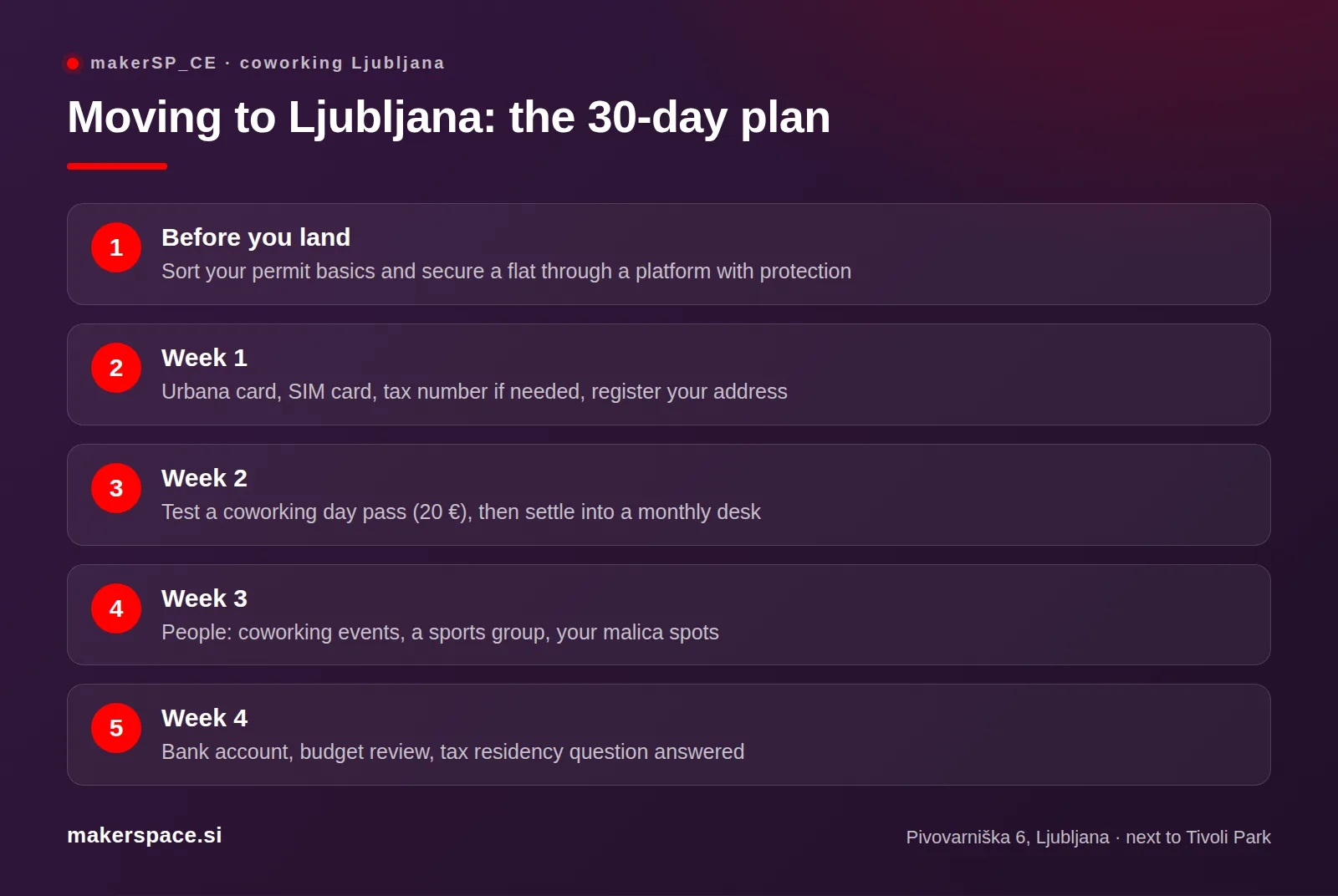
Moving to Ljubljana as a remote worker comes down to four weeks of admin done in the right order: paperwork and a flat before you land, transport, SIM card and registration in week one, a workspace and a routine in week two, people in week three, banking and a budget review in week four. Do it in that order and the city, which is small, walkable and safe, does the rest.
This is general information, not legal or tax advice. Permit, registration and tax rules depend on your citizenship, your employer’s location and how long you stay, so confirm your own case on gov.si or with a lawyer or accountant before relying on anything here. For the bigger picture of working from the city, start with our Ljubljana digital nomad guide; this article is the move-in manual.
Before you land: permits, housing and scam-proofing
Citizens of EU and EEA countries can live and work in Slovenia under EU free-movement rules, with registration formalities after arrival. Everyone else needs a residence basis, and for remote workers the relevant new route is the temporary residence permit for digital nomads, in force since 21 November 2025. In outline: it is valid for up to one year and cannot be extended (you may reapply six months after it expires), it requires monthly funds of at least twice Slovenia’s average net salary (about 3,122 € at launch, a threshold that moves with the reference salary), and it only allows work for employers and clients based outside Slovenia. Applications go through a Slovenian embassy or consulate abroad, or a domestic administrative unit if you are already legally resident. The official announcement has the details, and our visa overview walks through the conditions.
Housing is the second pre-arrival job, and the tighter one. A one-bedroom flat runs roughly 650–770 € a month outside the centre and 900–950 € in it, and good flats go fast, especially in early autumn.
- Furnished monthly rentals: Flatio and Spotahome both list Ljubljana flats for monthly stays, with no-deposit options on Flatio; Airbnb has a monthly-stays filter for the region.
- Local portals: nepremicnine.net is the country’s largest property portal, and bolha.com is the general classifieds site where private landlords post.
- Scam-proofing: never transfer a deposit for a flat you have not seen in person or on a live video call, insist on a written contract, and prefer platforms that hold your payment until you have moved in.
Week 1: Urbana card, SIM card, tax number and your address

1. Urbana card. The card costs 2 €, a single bus ride is 1.50 € with free transfers for 90 minutes, and the general monthly pass is 37 €. Most of the centre is walkable, and getting around Ljubljana without a car is genuinely easy. 2. SIM card. Sort a local SIM or eSIM on day one; our internet, SIM and Wi-Fi guide compares the options and explains how the city’s connectivity holds up for calls. 3. Tax number (davčna številka). If you will earn taxable income in Slovenia, or simply need the number for a contract or a bank, foreign individuals apply with form DR-02 in person, by post or through a representative, and the tax authority (FURS) issues the certificate within eight days. 4. Register your address. Foreigners who stay beyond a short visit generally need to register their residence at the local administrative unit (upravna enota); deadlines and documents depend on your citizenship and your permit, so check the current rules on gov.si.
Week 2 of moving to Ljubljana: a desk and a routine

Once the admin is done, the flat stops being the right place to work. Week two is for choosing a workspace and building a routine.
Test before you commit. A coworking day pass in Ljubljana costs 20 € at makerSP_CE and gets you everything a member has: a fixed desk with a wired ethernet connection, a loan monitor, every cable and adapter, unlimited free printing, the meeting room and a 12 m² call room without a booking system, a kitchen with coffee and soft drinks, and a balcony over Tivoli Park. If the day works, a month is 135 €, VAT included, with no notice period, no minimum term, a price that never rises and the option to freeze the membership while you travel. Monthly members get 24/7 access with their own key or code, and the private car park 50 metres from the door is free.
One honest note: we have 18 desks and they are often taken, so ask about availability before you plan your week around us.
Week 3: people, sport and your malica spots
By the third week the paperwork is done and loneliness is the main risk. Ljubljana is small enough that repetition builds a social circle quickly, so pick regular places.
- Coworking events. The free events, workshops and get-togethers at makerSP_CE are where new members stop being new; our philosophy is colleagues and friends, not tenants.
- Sport. Tivoli Park is a minute from our door: running groups, the walk up Rožnik, picnic tables. Climbing, cycling and football groups welcome newcomers who commit to a regular slot.
- Malica. The weekday set lunch, soup plus a main for roughly 7–10 €, is the social meal of the working day. Find two or three spots near your desk and accept the first invitation.
- Language. English is spoken almost everywhere, but a beginner Slovenian course or a weekly language exchange is useful and a reliable way to meet people.
Week 4: bank account, budget review and the 183-day question

Requirements for opening a bank account differ from bank to bank, so email or call ahead; a passport and a Slovenian tax number are the usual starting point, and proof of address helps. A local account simplifies rent, utilities and Urbana top-ups.
Then review the budget with a month of real receipts. Rough 2026 figures:
| Item | Rough monthly figure |
|---|---|
| One-bedroom flat | 650–770 € outside the centre, 900–950 € in it |
| Utilities (85 m² flat) | about 270 € |
| LPP monthly pass | 37 € |
| Coworking desk, everything included | 135 € |
| Twenty weekday lunches | 140–200 € |
Finally, the tax question. Under the general rules you become a Slovenian tax resident if you spend more than 183 days in the country in a calendar year, or earlier if your habitual residence or centre of vital interests moves here. Residents are taxed on worldwide income, non-residents only on Slovenian-source income, and Slovenia has more than 50 double-taxation agreements. If you will pass 183 days, book an accountant in week four, not in April.

Common mistakes when relocating to Slovenia
- Paying for an unseen flat. The most expensive mistake foreigners make. View it, or use a platform that protects the payment.
- Assuming the permit is the tax answer. A residence permit and tax residency are separate questions with separate rules.
- Working from the flat for three months. Isolation creeps in quietly; a desk with people around it is cheaper than the productivity you lose.
- Skipping the tax number. Contracts, banks and landlords keep asking for it; get it in week one.
- Waiting for friends to appear. They arrive through repetition: the same desk, the same lunch crowd, the same Saturday hill.
Frequently asked questions
Do I need a visa to move to Ljubljana as a remote worker?
EU and EEA citizens do not; they register after arrival. Most other nationalities need a residence basis, and the digital nomad temporary residence permit (in force since November 2025) covers remote workers employed by or contracting for companies outside Slovenia, for up to one year. Rules depend on your citizenship, so confirm your route on gov.si or with a lawyer.
How do I get a Slovenian tax number as a foreigner?
Foreign individuals apply with form DR-02 at the tax authority (FURS), in person, by post or through a representative, and the certificate is issued within eight days. You need it if you earn taxable income in Slovenia, and in practice banks, landlords and clients ask for it too. Having a tax number does not make you a tax resident on its own.
How much does it cost to live in Ljubljana per month?
Rough 2026 figures: a one-bedroom flat at 650–770 € outside the centre or 900–950 € in it, utilities around 270 €, a 37 € bus pass, weekday lunches at 7–10 € and a cappuccino at about 2 €. A coworking desk with everything included is 135 € a month. One aggregator puts a single person’s total at about 1,860 €.
Where do remote workers work in Ljubljana?
Cafés for an hour, libraries for silence, and coworking spaces for calls, printing and a fixed desk. makerSP_CE next to Tivoli Park charges 20 € for a day pass and 135 € for a month, both with wired internet, a loan monitor, a call room, a meeting room, unlimited printing and free parking included. It has 18 desks, so check availability first.
When do I become a tax resident in Slovenia?
Under the general rules, after more than 183 days in the country in a calendar year, or earlier if your habitual residence or centre of vital interests is in Slovenia. Residents pay tax on worldwide income; double-taxation agreements with more than 50 countries can prevent double taxation. This is general information, so confirm your position with an accountant.
Final thoughts
Thirty days is enough to turn a move into a life if the order is right: permit and flat first, card and tax number next, then a desk, then people, then the bank. Do them in sequence and Ljubljana feels like home by the fourth Saturday.
When you reach week two, test a day at makerSP_CE and see whether the desk next to Tivoli Park suits you; book a 20 € day pass here.
Related reading
Book your desk at makerSP_CE
makerSP_CE coworking, Pivovarniška ulica 6, Ljubljana — right next to Tivoli Park. Day pass 20 €, week 70 €, month 135 €. 24/7 access, free parking 50 m from the door, meeting room and call room included.
Web: makerspace.si | E-mail: rezervacije@makerspace.si | Phone: +386 30 393 405


