
Digital nomad Slovenia taxes, in one sentence: the residence permit for digital nomads does not make you a Slovenian tax resident, but spending more than 183 days in Slovenia in a calendar year does, and so can moving your “centre of vital interests” here even earlier. Tax residents are taxed on worldwide income; non-residents only on Slovenian-source income. Everything else follows from that distinction.
This is general information, not legal or tax advice: Slovenian rules interact with your home country’s rules and with treaties, so have a licensed tax adviser look at your situation before relying on any of it. For the immigration side, start with our 2026 overview of the Slovenia digital nomad visa and the Ljubljana digital nomad guide.
What the digital nomad permit does, and what it does not do
Slovenia’s temporary residence permit for digital nomads entered into force on 21 November 2025. The essentials, per the official announcement on gov.si:
- Duration: up to one year and not extendable; you may reapply six months after it expires.
- Who it is for: remote workers whose employers or clients are based outside Slovenia. The permit explicitly keeps you out of the Slovenian labour market: no Slovenian clients, no Slovenian employer.
- Income rule: monthly funds of at least twice Slovenia’s average net monthly salary, per the latest figure in the Official Gazette. At launch this was reported at roughly 3,122 € a month; the threshold moves with the reference salary, so check the current figure.
- Where to apply: at a Slovenian embassy or consulate abroad, or at an administrative unit if you are already legally resident. Immediate family reunification is allowed.
What it does not do: decide your tax status. Holding the permit does not automatically make you a tax resident; residency is assessed separately, under the rules below. Plenty of people assume a “nomad visa” is also a tax arrangement. In Slovenia it is an immigration document, full stop.
Slovenia tax residency: the 183-day rule and two quieter triggers

The Financial Administration (FURS) treats you as a Slovenian tax resident if any of these applies, as set out on its page for non-residents:
1. Presence: you are present in Slovenia for more than 183 days in a calendar year. 2. Habitual residence: Slovenia has become the place where you habitually live. 3. Centre of vital interests: your personal and economic ties, such as family, home and business, sit mainly in Slovenia.
The first trigger is arithmetic. The other two are judgement calls and can apply before day 184: a nomad who rents a flat for a year, brings the family and moves banking and business here is building a centre-of-vital-interests case whether or not anyone counted the days. Keeping a home, a tax return and a family base elsewhere is a much cleaner story. Keep evidence for whichever is true.
Note the words “calendar year”: the count resets on 1 January, and the permit’s twelve months rarely line up with the tax year.
Resident vs non-resident: what Slovenia actually taxes

| Tax resident | Non-resident | |
|---|---|---|
| Trigger | More than 183 days, habitual residence or centre of vital interests | None of the three |
| What Slovenia taxes | Worldwide income | Slovenian-source income only |
| Treaty relief | Can reduce or eliminate double taxation | Can reduce or eliminate double taxation |
| Home country | May still claim you; the treaty typically settles it | Usually still taxes you as its resident |
That split is why the day count matters. What counts as Slovenian-source income in your set-up, given where the work is physically done and who pays you, is precisely a question for an adviser rather than a blog. If you invoice clients abroad, our guide to working for foreign clients covers the VAT and invoicing side.
Double taxation Slovenia-style is mostly handled by treaty. Slovenia has more than 50 double-taxation agreements in force, and FURS maintains the official list. A treaty can reduce or eliminate tax charged twice on the same income, and typically contains tie-breaker rules for when two countries both consider you their resident. Before assuming the worst, check the list.
2026 income tax brackets, for context
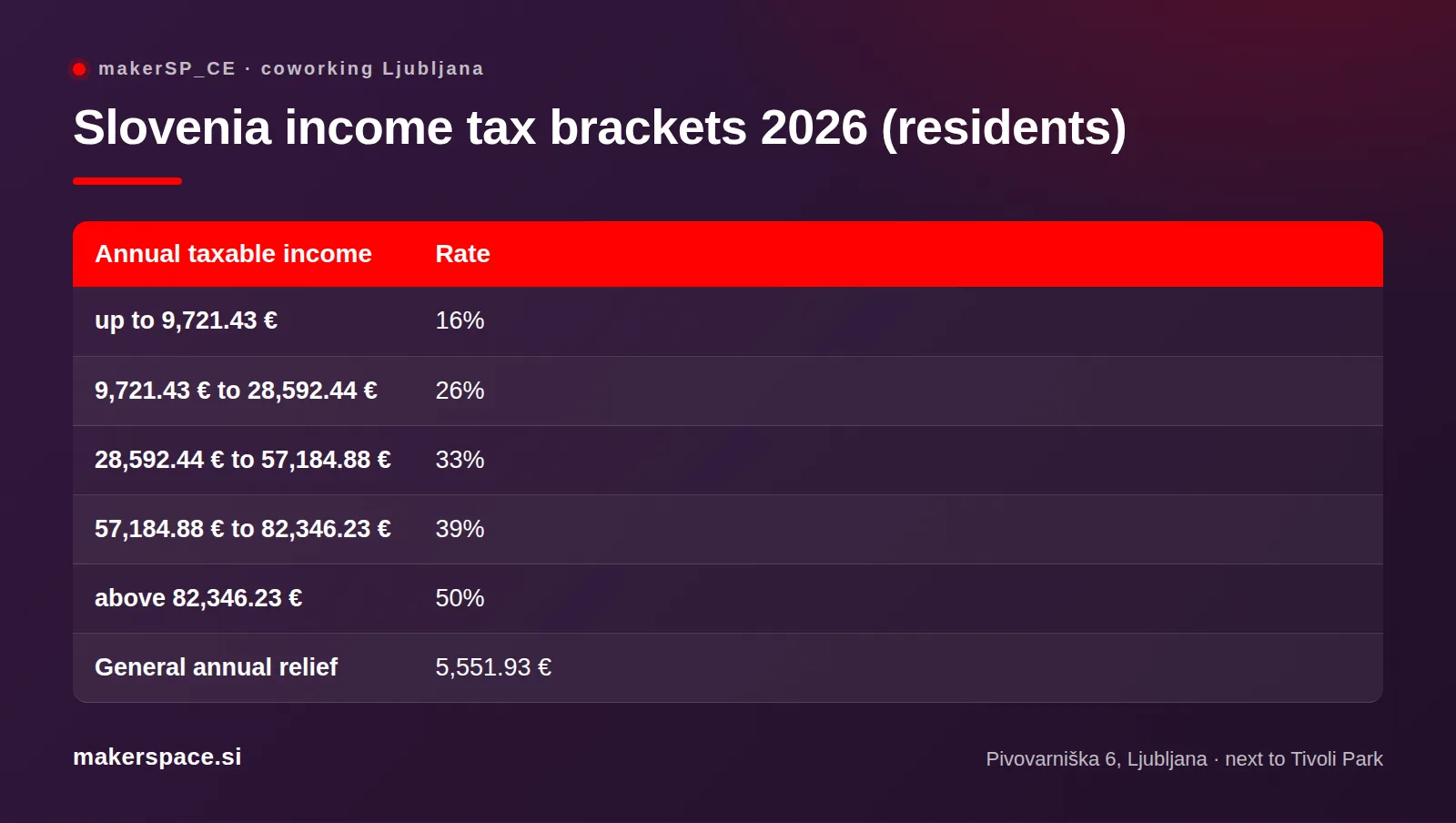
If you do become a resident, this is the 2026 personal income tax (dohodnina) scale, applied to annual taxable income:
- 16% up to 9,721.43 €
- 26% from 9,721.43 € to 28,592.44 €
- 33% from 28,592.44 € to 57,184.88 €
- 39% from 57,184.88 € to 82,346.23 €
- 50% above 82,346.23 €
The general annual relief is 5,551.93 €. The brackets are progressive: only the slice of income inside each band is taxed at that rate. We list them for orientation only; how your income is classified, which reliefs apply and what a treaty does to the result are adviser questions, and the scale changes yearly.
Tax number for a foreigner in Slovenia: form DR-02

A foreign individual without Slovenian residence who earns taxable income in Slovenia must obtain a tax identification number (davčna številka) via form DR-02, submitted in person, by post or through a representative; FURS issues the certificate within eight days.
Do you need one as a nomad? Not automatically. A non-resident with purely foreign income may never touch the Slovenian tax system; a resident, or anyone with Slovenian-source income, will. Get the number when a concrete obligation shows up, and keep the certificate.
The practical routine: count days, keep proof, book the adviser early
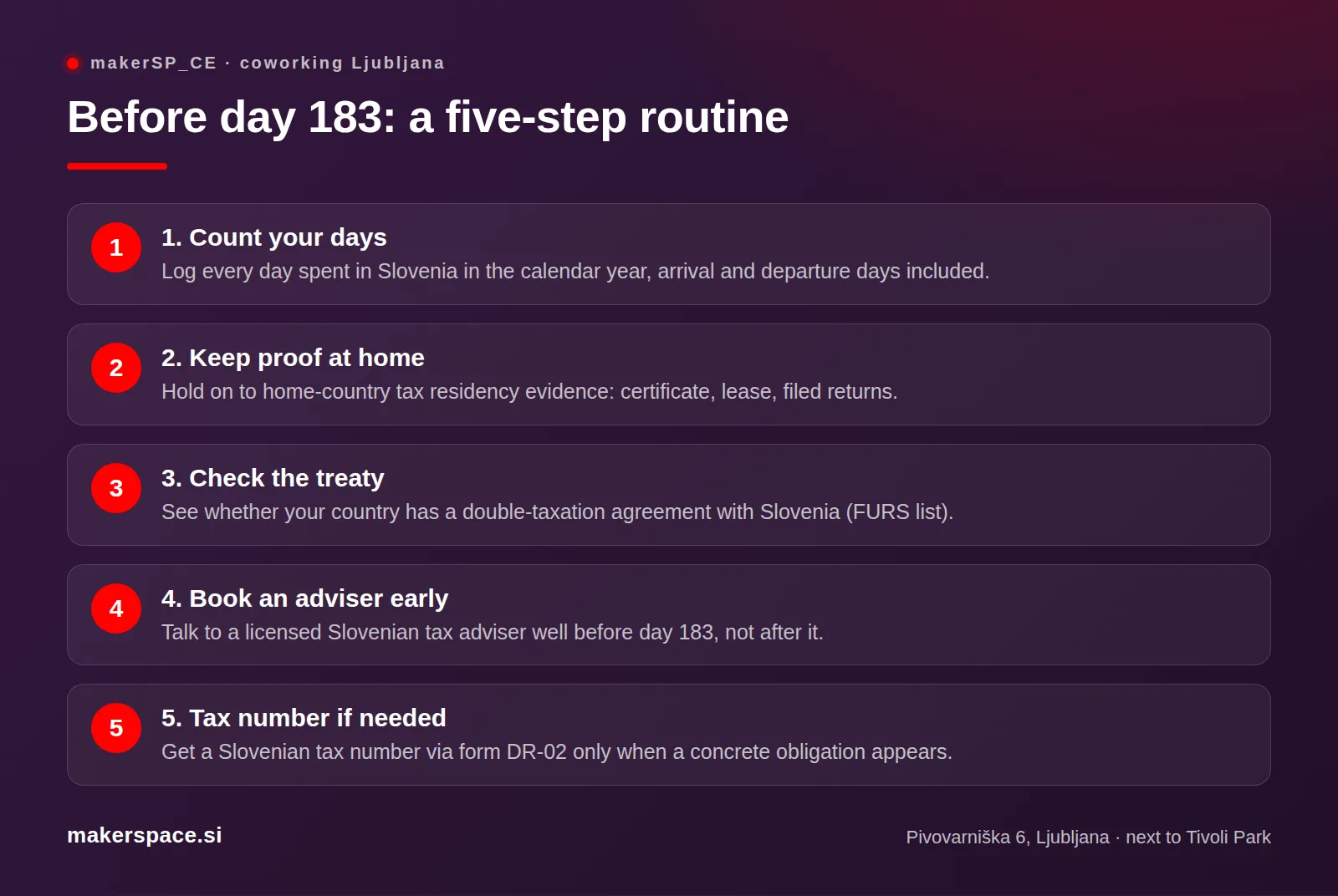
Most nomad tax trouble is not exotic: someone lost track of a date, threw away a lease or asked for advice in December about a year ending that December. The routine that avoids it:
1. Count every day. Keep a running log of days in Slovenia for the calendar year, arrivals and departures included, with booking confirmations as backup. If you are anywhere near 183, know it in April, not November. 2. Keep your home-country story intact. A tax residency certificate, a lease or property record and filed returns at home make non-resident status credible. 3. Check the treaty. Confirm whether your country has an agreement with Slovenia and what it says about residence. Ten minutes that can save months. 4. Book the adviser before day 183, not after. Our guide on how to choose an accountant applies to tax advisers too: ask specifically about cross-border individuals. 5. Match your commitments to your calendar. A twelve-month flat lease is a statement of intent; so is a workspace contract with a long notice period. Choose arrangements that end when you leave.
The last point is where we talk about ourselves, briefly. A monthly desk at makerSP_CE costs 135 € with no notice period, no minimum term and a price fixed for as long as you are a member; go travelling for a month and you can freeze the membership while your place stays reserved. A day pass is 20 €, a week 70 €. For a nomad managing a day count, that is a workspace rather than a tie. Our breakdown of what a workday in Ljubljana actually costs puts the numbers in context.
Frequently asked questions
Does the Slovenian digital nomad visa make me a tax resident?
No. The permit is an immigration document and does not automatically make you a tax resident of Slovenia. Tax residency is assessed separately: more than 183 days in a calendar year, habitual residence or a centre of vital interests in Slovenia. You can hold the permit and remain a non-resident, or become a resident without it.
How many days can a digital nomad stay in Slovenia without becoming a tax resident?
The bright line is 183 days in a calendar year: more than that and you are a tax resident on the presence test alone. Residency can also be triggered earlier if Slovenia becomes your habitual residence or centre of vital interests, so a shorter stay with a long lease and family moved here is not automatically safe. Count days; keep evidence of ties elsewhere.
Do I pay Slovenian tax on income from foreign clients as a non-resident?
Non-residents are taxed in Slovenia only on Slovenian-source income; residents on worldwide income. Whether income from foreign clients counts as Slovenian-source in your case depends on your set-up, and a double-taxation treaty may change the outcome. That is exactly the question for a licensed adviser before you start invoicing from a Ljubljana desk.
Do I need a Slovenian tax number as a digital nomad?
Only when there is a reason. Foreign individuals who earn taxable income in Slovenia must obtain a tax number via form DR-02, submitted in person, by post or through a representative; the certificate is issued within eight days. A non-resident with purely foreign income may never need one. Apply when a concrete obligation appears.
Does Slovenia have a double taxation agreement with my country?
Quite possibly: Slovenia has more than 50 double-taxation agreements in force, and the Financial Administration (FURS) publishes the official list. A treaty can reduce or eliminate being taxed twice on the same income and usually contains tie-breaker rules where two countries both claim you. Check the list, then ask an adviser how the treaty applies to you.
Final thoughts
The permit gets you into the country; the calendar decides your taxes. Count your days, keep the paperwork that proves where your life actually is, and involve a licensed adviser while the year is still young enough to plan. None of it is complicated; all of it is easier early.
If Ljubljana is on your route, we would be glad to be your base for however many days you decide to count: 18 desks next to Tivoli Park, 24/7 access for monthly members, a 12 m² call room and free parking 50 m away. The full price list is on our homepage.
Related reading
Book your desk at makerSP_CE
makerSP_CE coworking space in Ljubljana, Pivovarniška ulica 6 — right next to Tivoli Park. Day pass 20 €, week 70 €, month 135 €. 24/7 access, free parking 50 m from the door and a call room included.
Web: makerspace.si | E-mail: booking@makerspace.si | Phone: +386 30 393 405