

“I know how much I work.” No, you don’t – nobody does until they measure it. Your gut says four hours of focus; the stopwatch shows two and a half hours of work and an hour and a half of tab-hopping. For freelancers, tracking time isn’t bureaucracy but the cheapest business tool there is: working-time tracking reveals your true hourly rate, exposes time sinks and gives you a basis for better quotes.

Why track time even if you bill per project
- The real project cost: if a “two-day” project takes five days, you’ll never know without records – and you’ll underprice the next quote again.
- Your actual hourly rate: the project fee divided by the hours you measured is your real rate. It is often a wake-up call – and an argument for raising prices. We break the calculation down in our guide on how to set your hourly rate.
- Which clients are worth it: records by client reveal who pays fairly and who burns through twice the agreed time with “small extras.”
- Fewer guesses: measured data beats gut feeling in every business decision – from pricing to firing clients.
What actually counts as work
Track two things separately: billable hours (work for a specific client) and non-billable ones (quotes, admin, marketing, learning). The ratio between them explains why full working weeks don’t produce full invoices – and it is the key input for your hourly-rate calculation.
How to track without needless bureaucracy
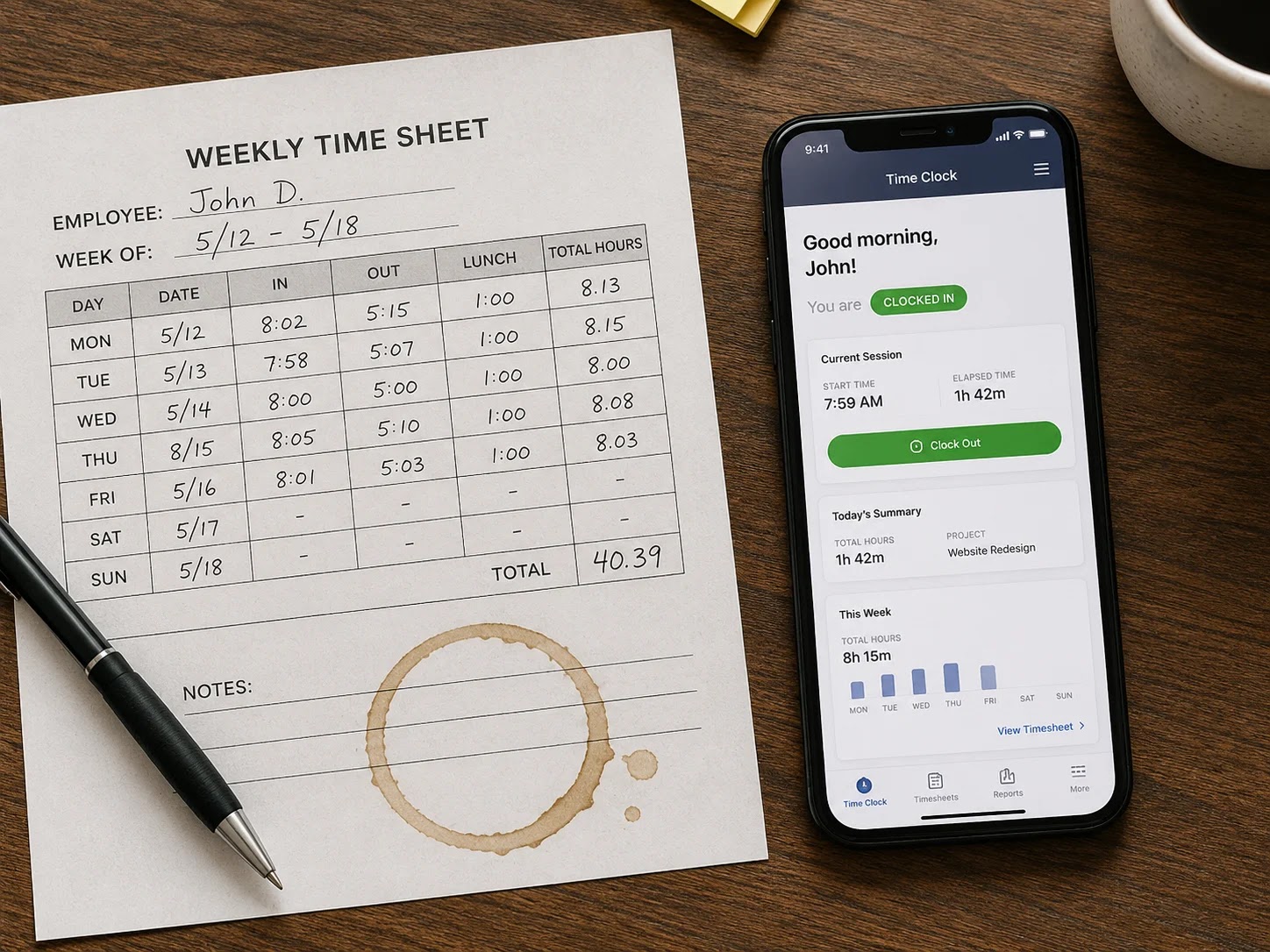
- As you go, not in hindsight: reconstructing a week on Friday afternoon is fiction. A timer or a quick note when you switch tasks takes seconds.
- Coarse categories: client + type of work is enough. A log with thirty tags dies within a week.
- Weekly review: ten minutes each Friday – how many billable hours, where the rest went, one thing to change next week.
- Any tool you like: a dedicated timer app, a spreadsheet or a sticky note – whatever you’ll actually use wins.
To squeeze the most out of the hours you measure, a task-sorting system helps too – see time-management techniques and how to prioritise work tasks.

If you have employees: records are not optional
For employers in Slovenia, keeping working-time records for employees is a legal obligation with prescribed data (arrival, departure, breaks, overtime). If you are or will soon be an employer, check the requirements with your accountant or at gov.si – this article covers voluntary tracking for your own business, where you set the rules yourself.
Hours also show where you work best
An interesting side effect of tracking: it shows where and when you get the most done. Members of the makerSP_CE coworking space often find that a morning at the coworking space produces more billable hours than a whole day at home – fewer interruptions, a clearer boundary, an environment where everyone works. At a €40 rate, just a few extra billable hours a month already cover the whole membership – and your records will prove it in black and white.

Frequently asked questions
Should I show the client my time records?
With hourly billing, a transparent breakdown of hours worked is a professional standard and builds trust. With a project price, your records stay an internal tool – the client buys the result, not your minutes.
How many billable hours a day is realistic?
Fewer than you think: 4 to 6 hours of truly billable work is a solid day for freelancers; the rest goes to admin, communication and sales. That is exactly why your hourly rate must also cover the non-billable part – the numbers from your records are the best input for that calculation.
Doesn’t tracking time kill creativity?
A timer isn’t a supervisor but a mirror. Track for yourself and use the data for decisions, not self-punishment – after a few weeks, logging becomes an invisible reflex.
Conclusion
Working-time tracking is to a freelancer what bookkeeping is to money: without it, you run the business on feel. Track as you go, separate billable from non-billable, review the numbers on Fridays – and let the data raise your prices, quotes and focus.
Related reading
- How to Set Your Hourly Rate: A Formula in 4 Steps
- Time Management Techniques: 6 Methods
- When a Client Doesn’t Pay: From Reminder to e-Enforcement
Book your spot at makerSP_CE
makerSP_CE coworking, Pivovarniška ulica 6, Ljubljana (by Tivoli Park). Fixed price, no notice period, 24/7 access and free parking.
Web: makerspace.si | Email: rezervacije@makerspace.si | Phone: +386 30 393 405